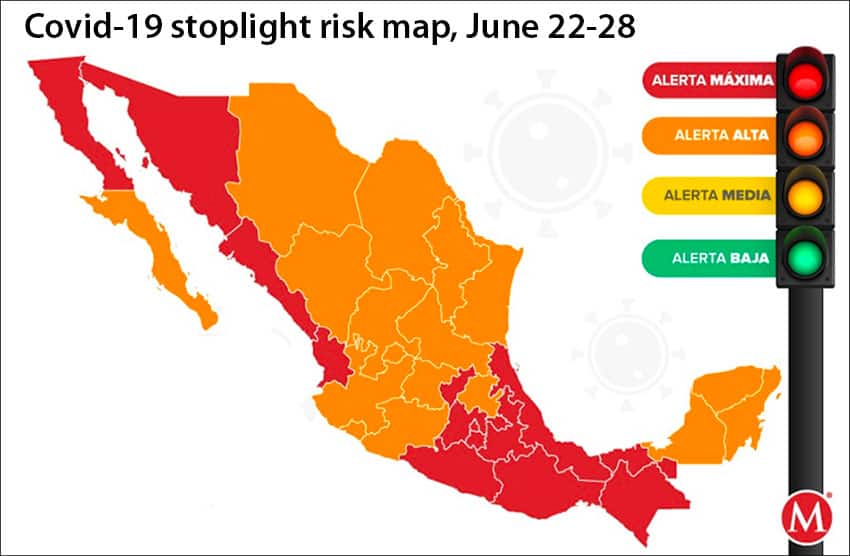
Seventeen of Mexico’s 32 states were allocated an “orange light” on the government’s updated “stoplight” map to assess the risk of coronavirus infection, an increase of one state compared to this week’s map.
Colima, which has recorded fewer Covid-19 cases and deaths than any other state, and Hidalgo switched from “red light” maximum risk to “orange light” high risk on the new map presented at the Health Ministry’s coronavirus press briefing on Friday night.
Tabasco, which currently has the fourth largest active coronavirus outbreak in the country, took a step back, switching from orange to red.
The other 29 states, including Mexico City, saw no change to the stoplight color they were allocated last week.
The stoplight system assesses states based on four factors: case number trends (whether new infections are increasing, decreasing or stable), hospital admission trends for coronavirus patients, hospital occupancy levels and positivity rates (the percentage of people tested who are confirmed to have Covid-19).
The 17 states allocated an orange light are Aguascalientes, Baja California Sur, Campeche, Chihuahua, Coahuila, Colima, Durango, Guanajuato, Hidalgo, Jalisco, Michoacán, Nuevo León, Quintana Roo, San Luis Potosí, Tamaulipas, Yucatán and Zacatecas.
The new stoplight colors and corresponding coronavirus restrictions will take effect on Monday. Health Promotion chief Ricardo Cortés presented the restrictions that should apply at both the red and orange light risk levels.

At the red light level, hotels should only operate at 25% capacity and common areas should remain closed, while at the orange light level, occupancy levels can increase to 50% and common areas can open at the same capacity.
Restaurants and cafes should only offer take-out and delivery in red states while they can operate at 50% capacity in orange states.
Hair salons and barbers shouldn’t open during the red light phase but can offer their services at people’s homes while following strict health protocols. They can operate at 50% of normal capacity in the orange light phase but by appointment only.
Parks, plazas and other outdoor public spaces are limited to 25% capacity in red states and 50% capacity in those allocated orange lights.
Supermarkets and markets shouldn’t exceed 50% of their normal capacity for shoppers while red light restrictions are in place and only one person per family should be allowed to enter. In orange states, the permitted capacity increases to 75% but the one person per family rule remains in place.
Professional sports matches are allowed in both red and orange light phases but must be played behind closed doors without spectators.
Gyms, swimming pools and sports centers should be closed in red states but can operate by appointment at 50% capacity in orange states. Cinemas, theaters and museums should remain closed in the former but can open at 25% capacity in the latter.
Shopping centers and places of worship should remain closed under red light restrictions but can open at 25% capacity in states with orange lights.
Bars, cantinas and nightclubs should remain closed regardless of whether a state has a red or orange light and events that gather large numbers of people remain suspended across the country.
There was some speculation that Mexico City, the country’s coronavirus epicenter, would switch to orange starting Monday but Mayor Claudia Sheinbaum said Friday that the capital is now hoping to ease restrictions starting June 29 instead.
If it is not possible to ease restrictions on that date, she said, the Mexico City government will offer additional economic support to affected residents. Sheinbaum said her government has already provided more than 200 million pesos (US $8.8 million) to people adversely affected by the coronavirus pandemic and associated economic restrictions.
The mayor called on all residents to act responsibility so that restrictions can be eased more quickly.
“We have to be responsible, let’s not drop our guard. … If you can continue staying at home, do it. If you go out, be strict in the use of face masks, [maintain] a healthy distance and wash your hands frequently,” Sheinbaum said.
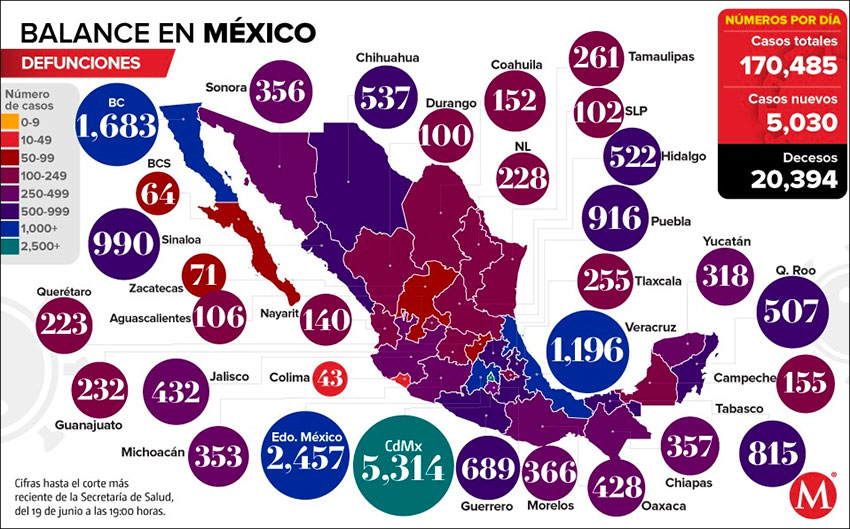
The capital still has the largest active coronavirus outbreak in the country and has now officially recorded more than 5,300 Covid-19 deaths.
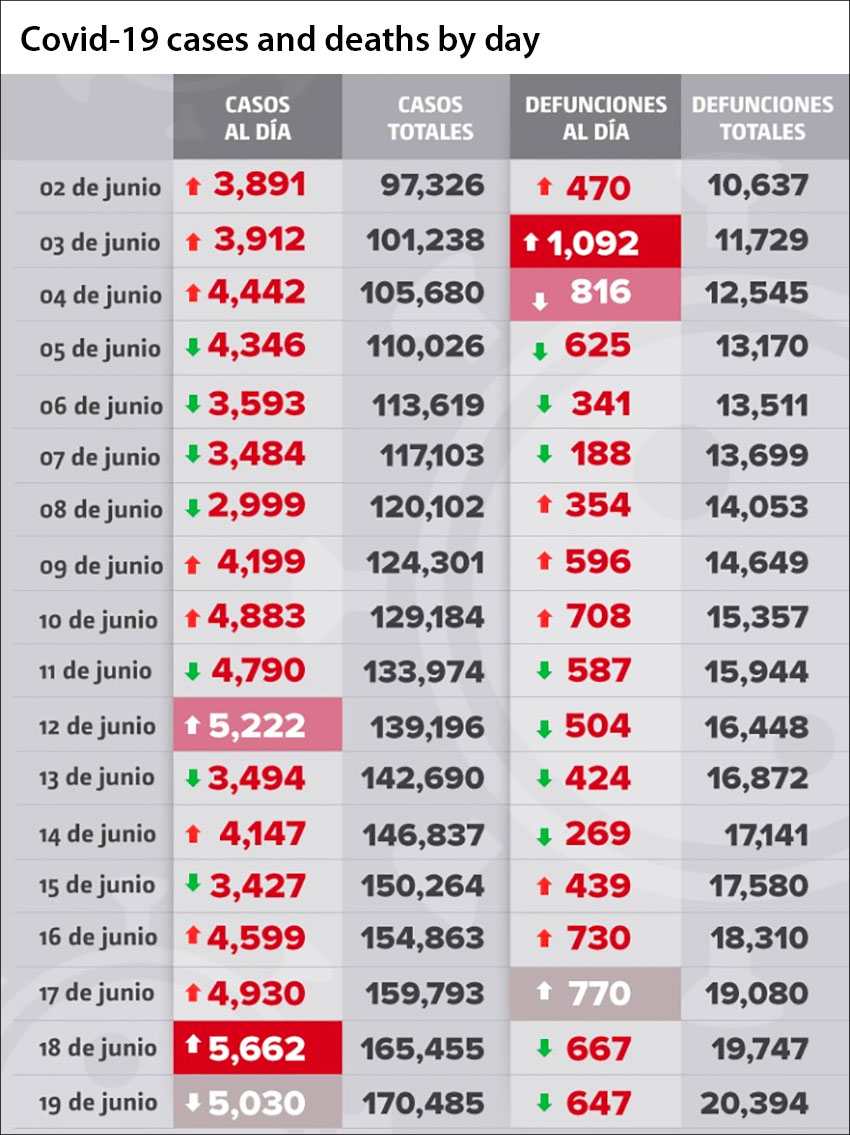
At the national level, the official coronavirus death toll passed 20,000 on Friday with 647 additional fatalities registered by federal health authorities.
The Health Ministry reported that 20,394 people are confirmed to have lost their lives to Covid-19 and that an additional 1,891 fatalities are suspected of having been caused by the disease.
It also reported that Mexico’s confirmed case tally had increased to 170,485 with 5,030 new cases registered on Friday. It was just the third time that more than 5,000 cases were reported on a single day.
Health Ministry data shows that 23,653 cases – 14% of the total – are currently active and that the results of 62,245 Covid-19 tests are not yet known. Almost 466,000 people have now been tested.
After Mexico City, which has 4,442 active cases, México state has the second largest active outbreak in the country, with 2,550 cases.
Five other states have more than 1,000 active cases: Puebla, Guanajuato, Tabasco, Jalisco and Nuevo León.
Source: Milenio (sp), El Financiero (sp)