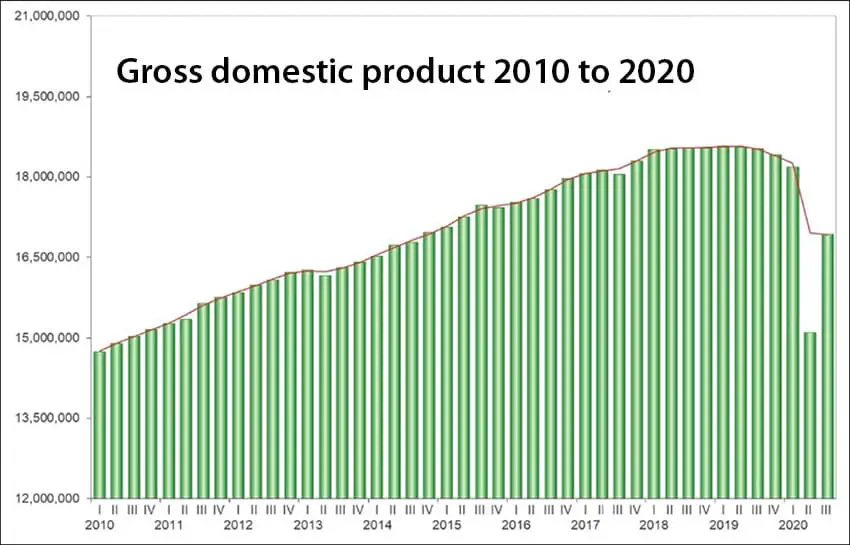
The Mexican economy bounced back strongly in the third quarter compared to the previous three months as industrial activity surged, but GDP was still well below 2019 levels.
Revised, seasonally-adjusted data published Thursday by the the national statistics institute Inegi showed that the economy grew 12.1% between July and September compared to the second quarter.
The quarter-over-quarter growth, 0.1% higher than that shown by preliminary data published late last month, was the highest since comparable data was first kept in 1990.
Economic activity in the secondary sector, including manufacturing, mining and construction, increased 21.7% between July and September compared to the second quarter but was down 8.8% compared to the same three months last year.
The primary sector, including agriculture, forestry and fishing, grew 8% compared to the second quarter but was down 8.8% annually, while the tertiary or services sector, including commerce, transport, financial and media, expanded 8.8% on a quarterly basis but contracted 8.9% compared to a year ago.
The quarter-over-quarter and annual statistics for the three individual sectors show that a recovery is underway but that the coronavirus pandemic and associated restrictions nevertheless continue to exact a heavy toll on the economy.

Overall GDP in the third quarter was 8.6% lower than in the same period of 2019. The year-over-year contraction follows an 18.7% decline in the second quarter, a period that included two full months – April and May – during which the government ordered the suspension of nonessential economic activities.
The economy was floundering even before the pandemic: GDP also declined on an annual basis in the first quarter of 2020 and the final three quarters of 2019.
According to Banco Base economic analysis director Gabriela Siller, the last time Mexico recorded six consecutive quarters of negative growth was in 1982.
It appears almost certain that Mexico will record its largest economic contraction since the Great Depression in 2020 even though the central bank on Wednesday revised its forecast upward for this year.
The Bank of México (Banxico) predicted a contraction of between 8.7% and 9.3% in 2020, an improvement from its previous quarterly report when it forecast a recession in the 8.8% to 12.8% range.
“There is still a high degree of uncertainty about the future evolution of both domestic and global activity; this is reflected in the breadth of the growth interval,” Banxico said.
For next year, the central bank is less optimistic than it was.
It is forecasting growth of between 0.6% and 5.3% in 2021 whereas in its previous report it predicted GDP expansion of 1.3% to 5.6%.
Banxico also predicted a net loss of 700,000 to 850,000 formal sector jobs this year and the creation of 150,000 to 500,000 in 2021. Both the former and latter predictions are more optimistic than those made by the central bank in its previous report.
Source: El Economista (sp), El Universal (sp), Reuters (en)