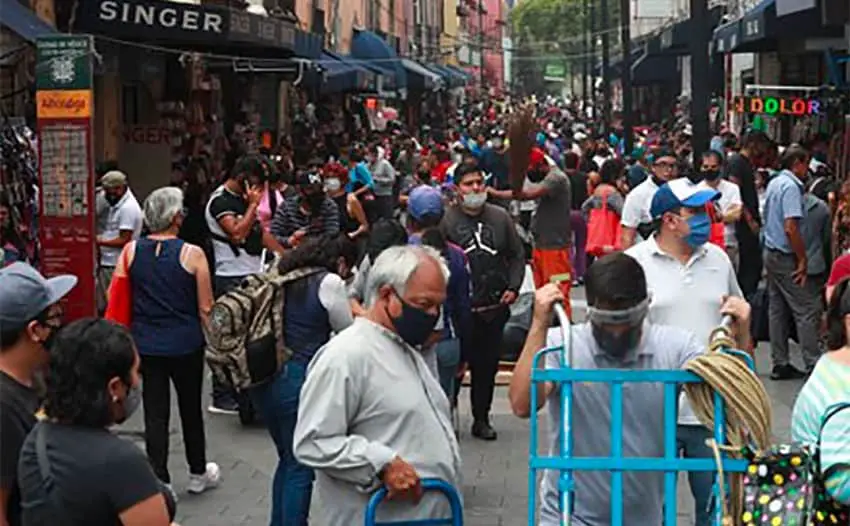
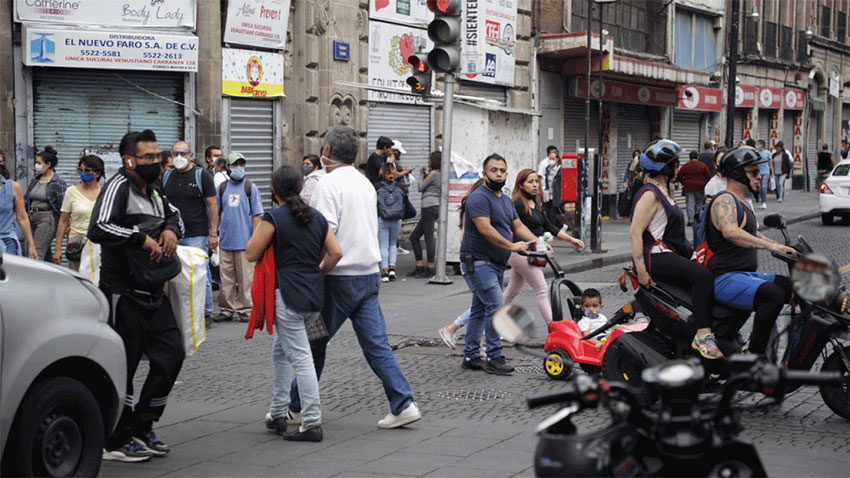
While Mexico City remains at high risk for the coronavirus, 27,000 businesses in the city’s historic center were permitted to reopen Tuesday, drawing large crowds of shoppers particularly concentrated in areas behind the National Palace and on Academia and Corregidora streets.
Social distancing measures were largely forgotten as the area swarmed with people shopping for clothing, shoes, jewelry and accessories after stores had been closed since April 7.
Masks were worn by some but not all as long lines formed in the streets to enter shops that for the most part followed guidelines to restrict shoppers to 50% of the stores’ capacity. Some offered antibacterial gel and took people’s temperatures before allowing them to enter.
Street peddlers lined the sidewalks offering items from baby clothes to face masks and plastic face shields, calling out to passersby as they hawked their wares. Many laid out their merchandise on plastic tarps spread out on the sidewalk.
Men with dollies, most of them without masks, were at the ready to help shoppers transport large purchases.
“If I had known it was going to get like this, I would not have come. A while ago I went through the Sonora market, La Merced, and people are walking normally, without face masks, without control. What scares me is a resurgence,” a man who was shopping for hardware items told the newspaper La Jornada.
Emma García, who walked at a brisk pace down 16 de Septiembre street clad in a mask, glasses and gloves, found the hordes of shoppers alarming.

“What they are doing to open is disastrous; we are all going to catch it because people don’t understand, but I also understand commerce …” she said in an interview with a radio station.
Officially, shops and businesses with an odd street number are permitted to open three days a week, Monday, Wednesday and Friday, whereas even-numbered shops can open Tuesday, Thursday and Saturday. Additionally, business hours are restricted to 11 a.m. to 5 p.m.
In order to prevent crowds from accumulating and promote social distancing, 31 streets were converted into pedestrian-only zones.
Juan Carlos López Villagrán, the owner of a dress shop on 20 de Noviembre street, said he’s happy to open his doors again, but concerned that shoppers won’t actually have the financial means to make purchases due to the economic crisis provoked by the pandemic.
He also said he has invested some 12,000 pesos (US $527) in purchasing masks, antibacterial gel, thermometers and other supplies to comply with government regulations.
Alejandro López, manager of a clothing store, tried to be hopeful.
“It was too many days of waiting to open again. We feel despair and anguish. Despair because the coronavirus does not stop for a single moment and anguish over the economic issue,” he said. “But at the end of the tunnel there will always be light and today is the day when we are going to start breathing again.”
In the country’s capital, the suspension of commercial activities caused an economic crisis that has led to the loss of 197,000 jobs, the city government reported on June 13.
Source: La Jornada (sp), Reporte Índigo (sp), Forbes (sp), Imagen Radio (sp)