While many manufacturers have been calling on the federal government to allow the reopening of factories that were closed due to the coronavirus, some in Ciudad Juárez, Chihuahua, never closed.
At least 28 factories classified by the government as nonessential are still operating in the northern border city, according to local media reports, including ones owned by United States aerospace company Honeywell, Mexican electronics firm Electrocomponentes and Swedish home appliance manufacturer Electrolux.
The factories have stayed open despite Juárez being the focal point of the coronavirus outbreak in Chihuahua, with 204 of the state’s 314 confirmed cases and 58 of the 67 deaths. The figures equate to an alarming fatality rate of 28 per 100 cases in Juárez – triple the national rate.
Workers and activists claim that the high number of cases in the border city compared to the rest of the state is due to factories and other nonessential businesses remaining open when they should be shut. Some workers say that have been forced to keep working if they want to keep their jobs.
Many at Honeywell protested last week because they haven’t been sent home on full pay, as the federal government ordered employers to do.
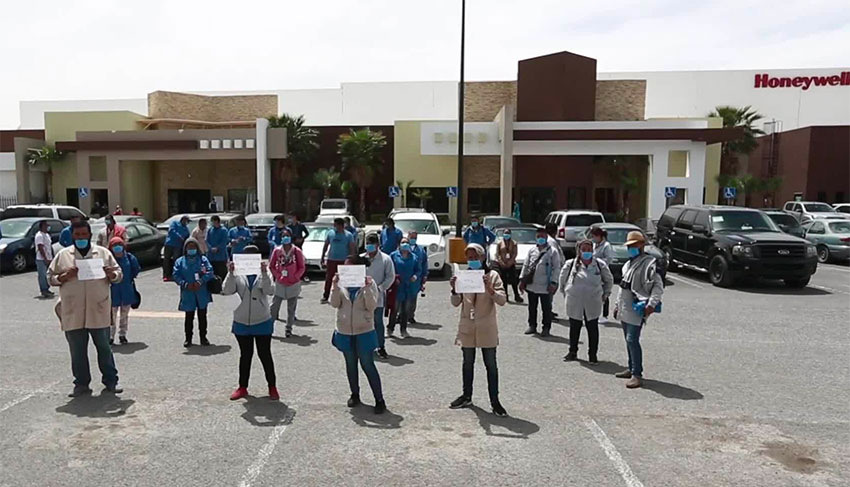
However, the company’s employees were still at work on Tuesday, according to the newspaper Milenio, which filmed workers leaving the factory at the end of their shift. Wearing face masks, the employees left the plant to board buses, Milenio said, noting that some failed to comply with the recommendations to maintain 1.5 meters of distance from each other and not to touch their faces.
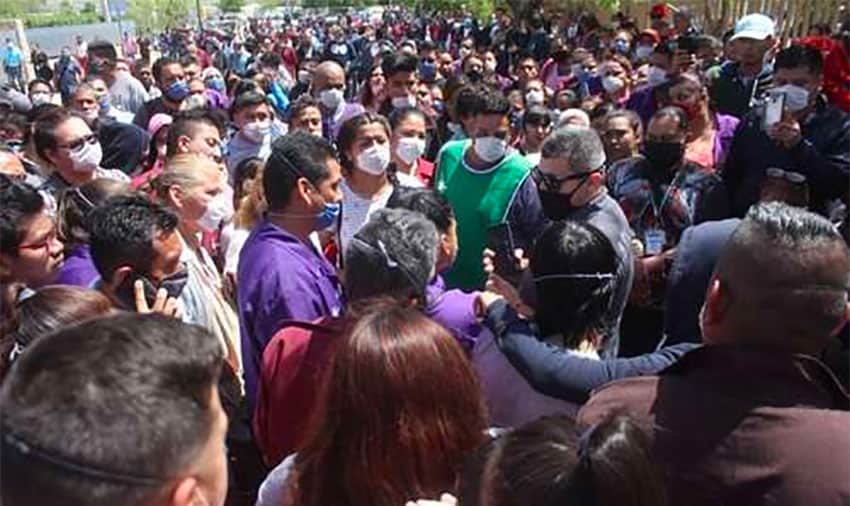
At least 500 workers at Electrocomponentes have also protested against their employer’s order that they continue to work during the emergency period. They also condemned the company for not granting leave to a female employee who is seven months pregnant.

Many of the factories that haven’t closed in Juárez are owned by United States companies, Milenio said, noting that they likely took the decision to remain open because they have an ongoing obligation to provide products to manufacturers in the U.S.
Many United States factories were classified as essential and have continued to operate even as the number of Covid-19 cases in that country soared.
The factories in Juárez that have refused to close have also violated an order issued by a Chihuahua court.
In response to an injunction request, Judge Madhay Soto Morales ordered the Chihuahua government on April 9 to close all nonessential factories. She also instructed the state Labor Ministry to carry out checks to verify that they had suspended operations.
Lawyer Carlos Joel Vargas argued that state authorities had failed in their responsibility to ensure that factories closed after the federal government ordered the suspension of all nonessential activities in late March.
In failing to uphold their responsibility, authorities have exposed factory workers and the general public to greater risk of being infected with Covid-19, he said.
Some factories in the Baja California cities of Tijuana and Mexicali, both of which have also recorded large Covid-19 outbreaks, have also defied the federal government order to close.
Deputy Health Minister Hugo López-Gatell said on April 15 that 15% of businesses in Mexico had not complied with the order and would be shut down. However, it is unclear how many businesses have since been forcibly closed and sanctioned.
Many factories that were forced to close are likely to be able to reopen soon after President López Obrador said last Thursday that he expected an agreement “in due course” that will allow manufacturers that contribute to the North American supply chain to begin operating normally again.
The government announced the next day that it would allow the reopening of automotive factories which it had previously deemed unessential businesses.
The announcement came after manufacturers in both Mexico and the United States, and U.S. government officials, called on the government to allow certain factories to reopen to maintain regional supply chains.
The health emergency stipulating the suspension of nonessential activities is scheduled to run though May 30.
However, the emergency declaration must be updated before April 30, providing the government with the opportunity to make modifications to the activities it considers essential. Automotive and aerospace are among the sectors that are expected to be given the green light to recommence activities as soon as May 1.
Source: Milenio (sp), La Jornada (sp)