Mexicali, Baja California, has now recorded more Covid-19 cases than Tijuana and ranks third among Mexico’s almost 2,500 municipalities for both accumulated and active cases, prompting the city’s mayor to implement stricter restrictions to curb the spread of the disease.
A total of 1,931 people have now tested positive for the infectious disease in Mexicali, a northern border municipality that adjoins California in the United States.
Tijuana, which until Monday had the highest number of accumulated cases in Baja California, has recorded 1,874 cases, according to the federal government’s Covid-19 municipal map.
At the municipal level, Mexicali now ranks third behind the Mexico City boroughs of Iztapalapa and Gustavo A. Madero for accumulated and active cases.
The border municipality currently has 453 active cases, according to Baja California government data, a figure that accounts for almost 70% of the 664 active cases in the state. Tijuana, by contrast, has 150 active cases, less than a third of the number in Mexicali, even though its population is almost double that of the state capital.
Tijuana, however, has a much higher coronavirus death toll, having recorded 466 fatalities, more than any other municipality in the country.
Mexicali has recorded 161 fatalities while Ensenada has the third highest death toll in Baja California with 34 people having lost their lives as of Monday.

Mexicali Mayor Marina del Pilar Ávila Olmeda announced a series of new restrictions aimed at reducing new infections.
Among them is a 7:00 p.m. closure order for all businesses that are not essential to maintaining people’s health, such as pharmacies. Ávila also said that checkpoints will be set up in different parts of Mexicali at which people will be asked to explain why they are not at their homes.
The ban on parties or other events that seek to gather large numbers of people remains in force, the use of face masks is obligatory in public spaces, travel in private vehicles is limited to essential activities and no more than two people are permitted to be in the same car at the same time.
Anyone found violating the restrictions will face harsh penalties, Mayor Ávila said.
State authorities have attributed the increase in Covid-19 cases in Mexicali to a failure by many residents to observe the restrictions in place. Some residents have even held parties at their homes, they say.
However, some labor groups claim that case numbers have gone up because many maquiladoras, or factories, have continued to operate despite orders to shut down.
The Baja California Ministry of Health reported last week that more than 400 factory workers in the state had tested positive for Covid-19, of whom just over 300 were hospitalized and 83 died.
According to data presented by the federal Health Ministry on Monday night, 63% of beds with ventilators are in use in Baja California, the second highest occupancy level in the country after Mexico City.
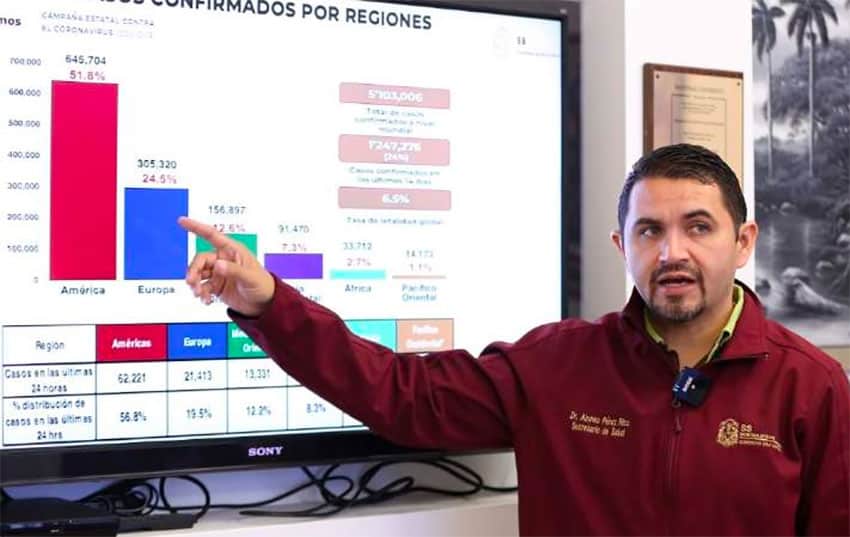
The health system in Tijuana, where about two-thirds of the approximately 700 coronavirus-related deaths in the state have occurred, came under intense pressure in late April, with Baja California Health Minister Alonso Pérez Rico describing a desperate situation with a severe lack of essential resources such as ventilators.
In that context, a federal judge on Monday ordered both state and federal authorities to provide all public hospitals in Tijuana with the supplies, equipment and medication they need to treat Covid-19 patients adequately.
The judge’s order came in response to a case brought by a plaintiff who argued that the hospitals in the border city don’t have the supplies and equipment they need to respond to the coronavirus.
Healthcare workers across Mexico have held numerous protests to demand they be given the supplies and equipment they need both to treat coronavirus patients and protect themselves from infection.
Most recently, employees of the National Institute of Respiratory Diseases in Mexico City protested on Monday to demand greater supplies of personal protective equipment such as N95 masks and medical gowns.
Source: El Universal (sp), Milenio (sp), Border Report (en)