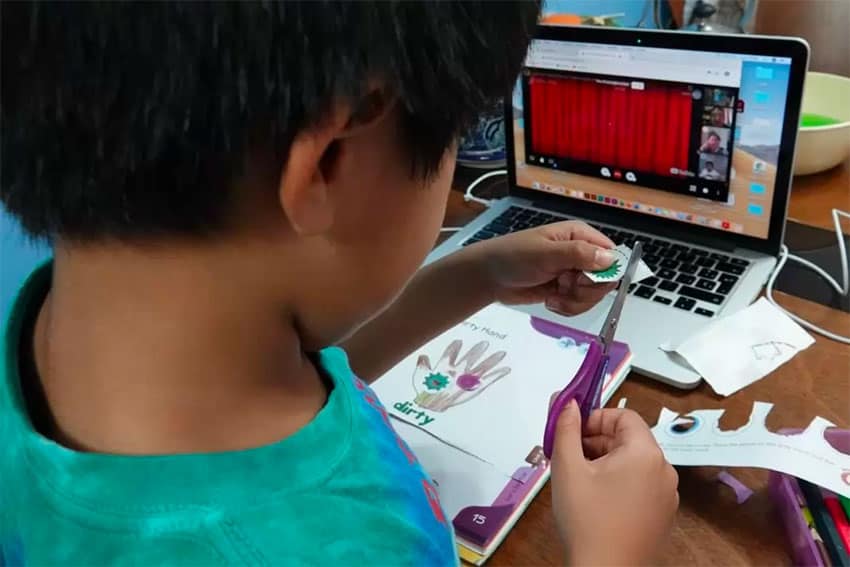
Almost 9 million students aged 3 to 29 abandoned their studies during the 2020-2021 school year due to the coronavirus pandemic, a lack of money or because they had to work, according to the national statistics agency Inegi.
Results of an Inegi survey on the pandemic’s impact on education show that 8.8 million children, teenagers and young adults were forced to abandon their studies this academic year, which began virtually last August.
That figure is higher than the entire population of Jalisco and almost equal to that of Mexico City (excluding the greater metropolitan area).
Of the 8.8 million students who stopped studying, 2.3 million did so for reasons directly related to the pandemic, 2.9 million left their educational institutions due to a lack of resources (meaning their families couldn’t afford to pay expenses associated with online learning) and 3.6 million made the decision because they had to work.
An additional 738,000 students abandoned their studies during the 2019-2020 school year. Almost 60% of that number cited the pandemic as the reason why they left.
The Inegi survey also found that students are dedicating significantly less time to their education while studying virtually at home. Only 11.8% of students spend eight hours per day or more attending virtual classes and doing schoolwork, while 48.3% spend three to five hours studying and 23.5% dedicate fewer than three hours of their time to their education.
In addition, the survey found that more than a quarter of households where students live had to purchase electronic devices and/or install internet service so that they could study during the suspension of in-person classes.

The most commonly cited advantage of virtual classes was that students’ health is not placed at risk while the No. 1 disadvantage was that learning is not as successful as it is in the classroom.
Manuel Gil Antón, an education researcher at the Colegio de México, told the newspaper El Universal that the pandemic has deepened educational inequality in Mexico.
Mexico’s poorest children – “the forgotten ones” – have been most affected by the shift to online learning and have left schools in the greatest numbers, he said.
Gil pointed out that poor households usually don’t have computers and charged that the Ministry of Public Education (SEP) “could have done things better.”
“It could have been more creative, delivered less generalized content,” he said.
Alma Maldonado, an education researcher at the National Polytechnic Institute, said the Inegi numbers are indicative of the failure of SEP’s education strategy during the pandemic. She asserted that its online curriculums have been largely irrelevant to students’ needs and have failed to appeal to them.
Maldonado also said there has been a lack of support for teachers giving the virtual classes, although she acknowledged that educators have done their best. She asserted that it will take years to recover pre-pandemic school enrollment levels.
Schools closed due to the pandemic a year ago and have not reopened in any state in the country, but President López Obrador said Thursday morning that classes could resume soon in Chiapas, Veracruz, Sonora and Chihuahua, depending on the coronavirus risk level as established by the stoplight risk map. Sonora, Campeche and Chiapas are already green, the color at which schools may reopen.
A large association of private schools, many of which have seen their revenue plummet during the pandemic due to students moving to public schools, called for its members to reopen on March 1 but the Education Ministry quickly warned that reopening would be a violation of government policy.
Source: El Universal (sp)