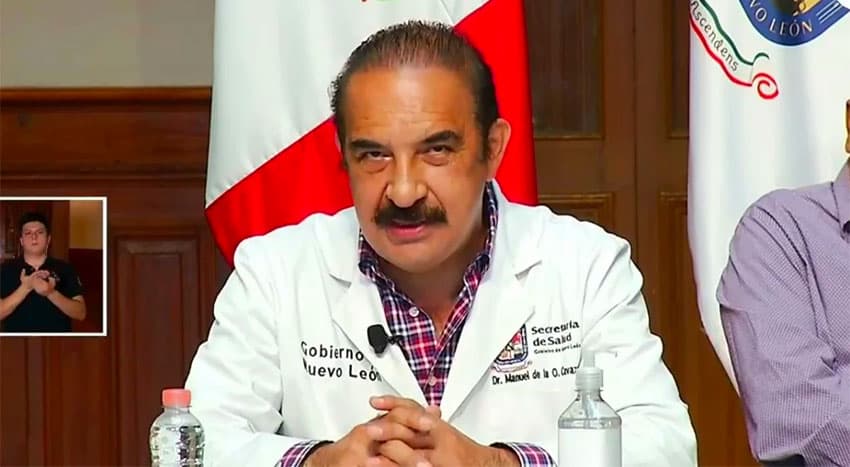
The Nuevo León health minister has rejected the federal government’s orange light assessment of the coronavirus risk in the state, asserting that it is in fact “intense red.”
The federal Health Ministry announced Friday that the risk level in the state would remain at orange light “high” this week, although health promotion chief Ricardo Cortés said that state as well as Coahuila and Durango could switch to red if their coronavirus outbreaks don’t decline.
Even before that warning, Nuevo León authorities considered the risk level to be red light “maximum,” said state Health Minister Manuel de la O Cavazos.
He noted that the Nuevo León government’s coronavirus numbers are significantly higher than the federal government’s numbers for the state because the former includes cases detected at private hospitals and laboratories whereas the latter does not.
As of Sunday, the state’s confirmed case tally was 78,389, according to the Nuevo León government, 27,343 higher than the federal government tally. The state government has counted 4,381 Covid-19 deaths but federal authorities have only registered 3,738.
De la O Cavazos said that without its high testing rate, Nuevo León would be considered a green light “low” risk state. However, at the same time people would be dying “in the streets and in the hospitals,” he said.
Due to the recent increase in case numbers, hospitalizations and deaths over the past two weeks, state authorities decided not to go ahead with a plan to reconfigure hospitals and thus reduce their capacity to treat coronavirus patients, the health minister said.

Four hospitals in the municipalities of Montemorelos, Juárez, Sabinas Hidalgo and Monterrey were all slated to stop accepting Covid-19 patients but will continue to do to ensure that there are sufficient beds.
He called on the federal government to provide more medical supplies, pointing out that providing health care is an expensive exercise and that it’s up to federal authorities to cover the costs. The state government “has made a great investment” in health but its resources are “finite,” he said.
The health minister announced that cemeteries in Nuevo León will not be open to the general public during the Day of the Dead holiday on November 1 and 2 to avoid large gatherings of people. Police will ensure compliance with the restriction, he said.
Public Day of the Dead events have been canceled in many states due to the coronavirus outbreak, although some are going ahead in a Covid-safe way.
The pandemic has taken a heavy toll on Mexico – the country’s accumulated case tally increased to 891,160 on Sunday and the official Covid-19 death toll rose to 88,924.
However, the Health Ministry acknowledged Sunday that the real death toll is much higher. It said that there were 193,170 excess deaths between January and late September and that 139,153 were attributable to Covid-19.
Source: El Universal (sp)