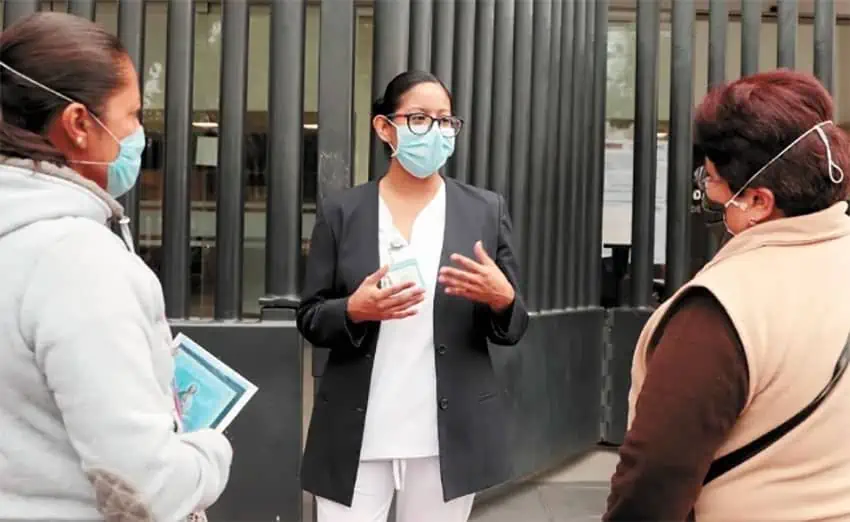
For some Covid-19 patients, the face of Laura Martínez de la Luz is the last they ever see, but the Mexico City nurse makes sure that they know their families loved them to the very end.
Martínez, 31, has devoted extra time to running messages between coronavirus patients and their worried loved ones who wait outside the hospital daily in hopes of receiving good news.
She arrives an hour before her shift begins at the hospital in the southern borough of Tlalpan in order to collect letters they have written to their sick relatives and offer emotional support.
She said she is not afraid of contracting the virus and even feels as though she found her calling treating Covid-19 patients.
“My tranquility arrived the day I entered the Covid [unit]. I love it. The first day I entered, I left smiling because you see the needs in there and you look for strategies to improve a lot, both among hospital staff and patients,” she said.
Playing the messenger between families and patients has been a gratifying experience for her and her fellow nurses. She recites the letters aloud to those who cannot read, and leaves the letters in a plastic bag at the head of the beds of those who are intubated “so that when they wake up they’ll know that the letters are there.”
All letters that make their way into the coronavirus ward are disposed of to avoid further transmission, independent of whether or not the patient survives the disease, and for this same reason patients are not allowed to send letters back to their worried loved ones.

“The first day that I gave a patient [a letter], the man cried. He couldn’t tell me thank you through the sobs so I left him. I came back later and asked him how he was and he said, ‘I’ve been waiting for that for a week. Thank you.’”
Martínez said that she and her fellow nurses and doctors are filled with sadness every time a Covid-19 patient dies, as the last time they saw their families was when they entered the hospital.
“It fills our hearts with anguish, and with rage because of all those who don’t believe [that the pandemic is real] and who say that we’re killing [coronavirus patients]. … We studied to save lives, not to kill,” she said.
Fear of the virus has led to harassment and attacks on nurses and other medical staff throughout the pandemic.
Outside the hospital, Reyna and Angélica await news of their sick loved ones. Preferring not to give their last names, they said that Martínez has helped them a great deal during a difficult time. Reyna’s sister is intubated and recent news has not been encouraging.
“We’ve been here 14 days since Laura began coming by and since then … the whole family writes [my sister], one day one family member, the next day another. [Laura] arrived on a day when we were all sad because of the report they gave us and she was like a ray of sunshine,” said Reyna.
Angélica also thanked Martínez for being there every single day to take the family’s messages of hope and encouragement to her brother-in-law, who is also on a ventilator.
Source: El Universal (sp)