Demand for a Mexican-designed earthquake protection capsule is on the rise, according to its creator.
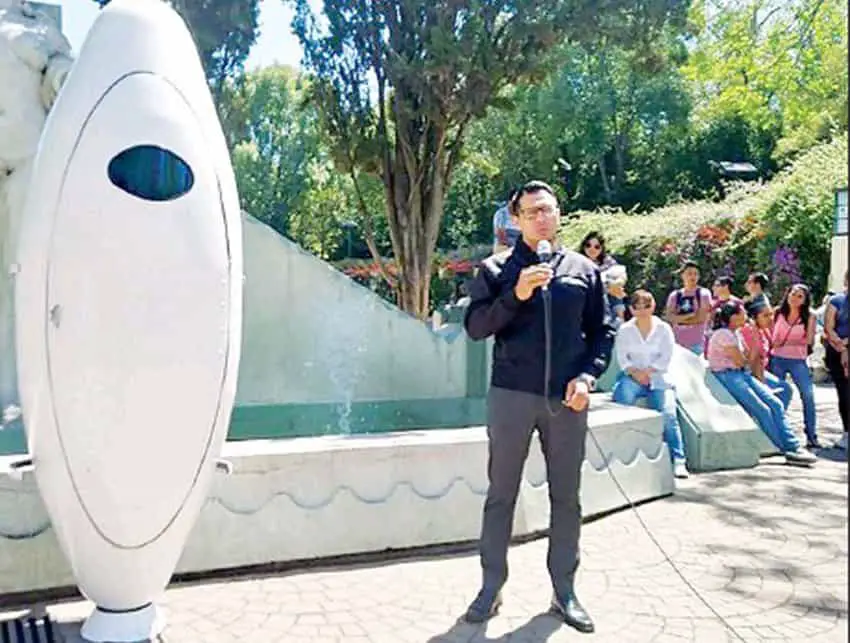
Reynaldo Vela told the newspaper El Universal that he is currently filling 15 orders a month for his Cápsula K107, inside which he says a person could survive for up to a month while trapped under earthquake rubble.
Before the September 19, 2017 earthquake that devastated parts of central Mexico, the 32-year-old inventor had only sold a grand total of three capsules.
Based on the shape of a velociraptor dinosaur egg, each capsule comes replete with food and water supplies for 30 days and is equipped with an oxygen tank, seismic alert sensors, seatbelts, a radio, a GPS beacon and a compartment for fecal matter.
They are made in Vela’s plant in the Mexico City borough of Iztacalco.
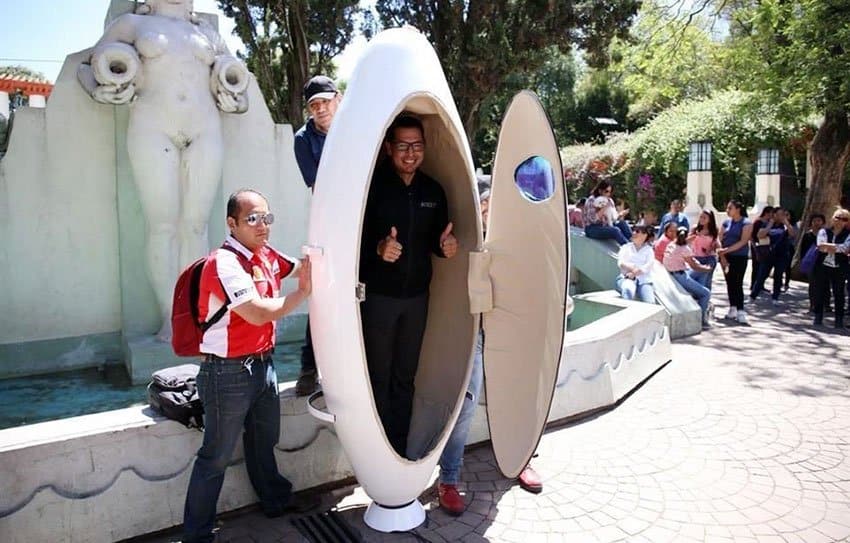
The capsules are custom made to client’s individual specifications and have a capacity for resistance of between 40 and 600 tonnes.
“The most basic capsule [is designed] for a house and is made out of steel and other alloys. The most resistant could have titanium, fiberglass rods, resins and polyurethane,” Vela said.

Prices range from 40,000 pesos (US $2,000) to 260,000 pesos (US $13,000).
Vela explained that all the capsules he makes are designed to withstand the force of a building collapsing on top of them but the most expensive model could withstand the weight of a skyscraper such as Mexico City’s Torre Mayor.
The capsules he has made so far are capable of protecting as many as three people, depending on their body size, but Vela said that it would be possible to make one for as many as 30 people, which would be ideal for use in a school classroom.
The Cápsula K107 is the result of eight years of research during which a variety of different shapes were tested to determine which was most resistant to the force of a falling building.
“. . . We tested parallelepipeds, cubes, all sorts of geometric shapes until we got to the shape of an egg – a conventional bird one. That allowed us to say that it was the best geometric shape to resist the force of an impact,” he said.
However, Vela explained that the shape still wasn’t as strong as he wanted but on the advice of a paleontologist he tried out the shape of a velociraptor egg.
“The paleontologist gave us a fossil from which we made a mold, with which we were able to carry out a test . . .[The velociraptor egg shape] is more resistant than a conventional egg because its more elliptic and under that principle the Cápsula K107 was built . . . With this we can guarantee . . . [that it will resist] all the force of a collapsing building,” he said.
Although it has never been tested in a real earthquake, Vela is confident that his invention won’t fail when the next big one strikes.
“It’s an investment to save your life,” he said.
Source: El Universal (sp)