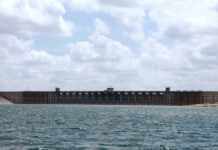
The governor of Jalisco has presented a 533-million-peso (US $27.8-million) development plan for the Lake Chapala region, one of whose priorities is the study of a train service between Guadalajara and Chapala.
Enrique Alfaro said yesterday the plan is intended to provide social justice, economic development, improved security and more effective government for the more than 300,000 people who call the region home.
He also said that natural resources and the environment will be protected and that the different municipal governments in the region will work together to implement the plan.
More than half the funds – just under 303 million pesos – will go to upgrading highways and roads in the area, which includes the municipalities of Jocotepec, Chapala, Poncitlán, Tuxcueca, Tizapán el Alto, Ocotlán and Jamay.
Rehabilitation of the Jocotepec-Chapala is considered a priority project.
More than 26 million pesos will be allocated for the improvement of the region’s healthcare clinics, while funds have also been set aside to undertake a clean-up of Lake Chapala, which is polluted by a range of contaminants including arsenic and ammonia.
The lake will also be restocked with carp and tilapia. The plan’s goal is to release one million hatchery fish into the lake next year.

During a tour of the region yesterday, Alfaro went for a cruise on the lake and bumped its fish population by 250,000 with the release of young fish.
José Luis Valencia, chief of the state government’s strategic projects agency, said the development plan will also provide funding for Isla de Mezcala, a small island in Lake Chapala, and the Chapala Media Park, a technology precinct.
Financial support for companies will be made available via the Jalisco Business Promotion Fund, he said.
Alfaro said another priority project will be a train running between Chapala and Agua Azul in Guadalajara. He said the state is working with the railway company Ferromex to develop the project.
“. . .We’re doing the topographic surveys, they’re progressing and very soon we’re going to have a project ready. . .” and know how much money will be required, he said.
In addition, money could also go to sporting, tourism, education, agricultural, fishing and sewer projects as well as the establishment of new military facilities.
The launch of new transportation services on Lake Chapala and gastronomic corridors are under consideration as are the establishment of new markets, makeovers for lakefront promenades, a new bicycle path and a clean-up of the Santiago river.
However, Alfaro said that all potential projects must first be approved by committees that will be made up of government officials, members of the business sector, civil society organizations and citizens.
The governor added that he will personally supervise the progress of the plan.
Both state and federal governments provided funds for it.
Source: Milenio (sp), Informador (sp)