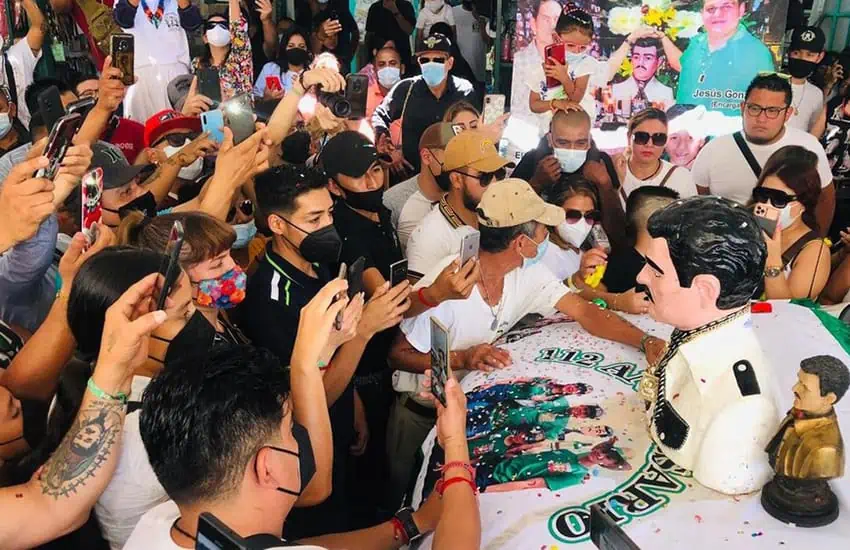
Thousands of devotees of Jesús Malverde – “the narco-saint” – flocked to his chapel in Culiacán, Sinaloa, on Monday to pay their respects on the 112th anniversary of his death.
Banda sinaloense musicians played as people filed into the chapel one by one to leave candles, flower bouquets, alcoholic beverages and other offerings to Malverde, a Robin Hood-type figure who is believed to have lived between 1870 and 1909, although his existence is not historically verified.
Whether he existed or not, Malverde — also known as “the generous bandit” — has countless followers not only in Sinaloa, a state notorious for its drug traffickers such as Joaquín “El Chapo” Guzmán and Rafael Caro Quintero, but also in many other parts of Mexico and beyond.
Jesús Manuel González Sánchez, son of the founder of the chapel and the current administrator, told the news website Debate that people began arriving early Monday morning even though it had been announced that there would be no celebrations due to the coronavirus pandemic.
However, the chapel management relented, bringing out a bust of Malverde for the admiring masses and allowing eight bands to liven up festivities at the chapel, located just outside Culiacán’s downtown area.
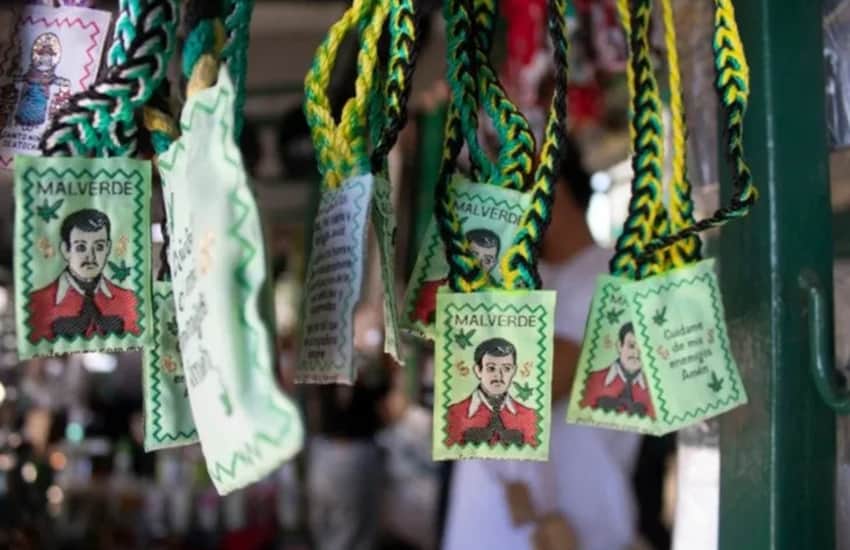
Compared to previous years, fewer people arrived to pay their respects to the “the narco-saint,” but devotees nevertheless numbered more than 3,000.
“The truth is that because of Covid-19, we thought that not so many people would come, but they have a lot of faith. … They come to thank [Jesús Malverde] and leave their candles,” González said.

Many people arrived to thank Malverde for what they believe are miracles granted by “the angel of the poor,” another nickname for the saint.
One man, Juan Ignacio, has been going to the chapel for 25 years to thank Jesús Malverde for helping his son to walk again after he was paralyzed as the result of a seizure. He said that he and his family prayed to the saint and, “thanks to Malverde, he now walks.”
María Luisa Alvarado Valdés, a long-term Valverde adherent whose son was unable to walk for seven months after being hit by a car, related a similar story. She claimed that Malverde not only helped her son to walk again but also blessed him with a family of his own.
Karla Celeste Robledo traveled from Orlando, Florida, to pay her respects. She said she has written a corrido, or ballad, about “the narco-saint” called la Reyna de Sinaloa (The Queen of Sinaloa).
“… I left Sinaloa when I was very young. I just bought my first statue [of Malverde]. … It’s not something bad [to be a devotee of him],” she told the newspaper Milenio.
According to the mythology of Malverde’s biography, the man who would go on to become a much-loved folk saint suffered poverty and many other injustices in his childhood. Consequently, as an outlaw in his adult life, he robbed landowners and wealthy families and used the proceeds of his crimes to help the poor.
His status as “a criminal with a heart” has won him legions of devotees, at least some of whom are involved, or have been involved, in illegal activities such as drug trafficking.
Source: Milenio (sp), Debate (sp), Línea Directa (sp)