High levels of ozone pollution prompted Mexico City authorities to reactivate a phase 1 environmental alert on Thursday, forcing a large number of cars off the road on Friday.
The Environmental Commission of the Megalopolis (CAMe) reactivated the alert at 4 p.m., just 20 hours after a previous alert was lifted.
It said in a statement that ozone levels had reached 168 parts per billion (ppb) at a monitoring station in the borough of Benito Juárez and 155 ppb at a station in Iztacalco. The city government considers concentrations of ground-level ozone over 70 ppb to be unhealthy.
CAMe said that a high-pressure system over the Valley of Mexico regained strength on Thursday, intensifying atmospheric stability with “variable wind of weak intensity.”
The climatic conditions, including “intense solar radiation,” caused an increase in ozone concentrations, which resulted in “extremely bad” air quality.
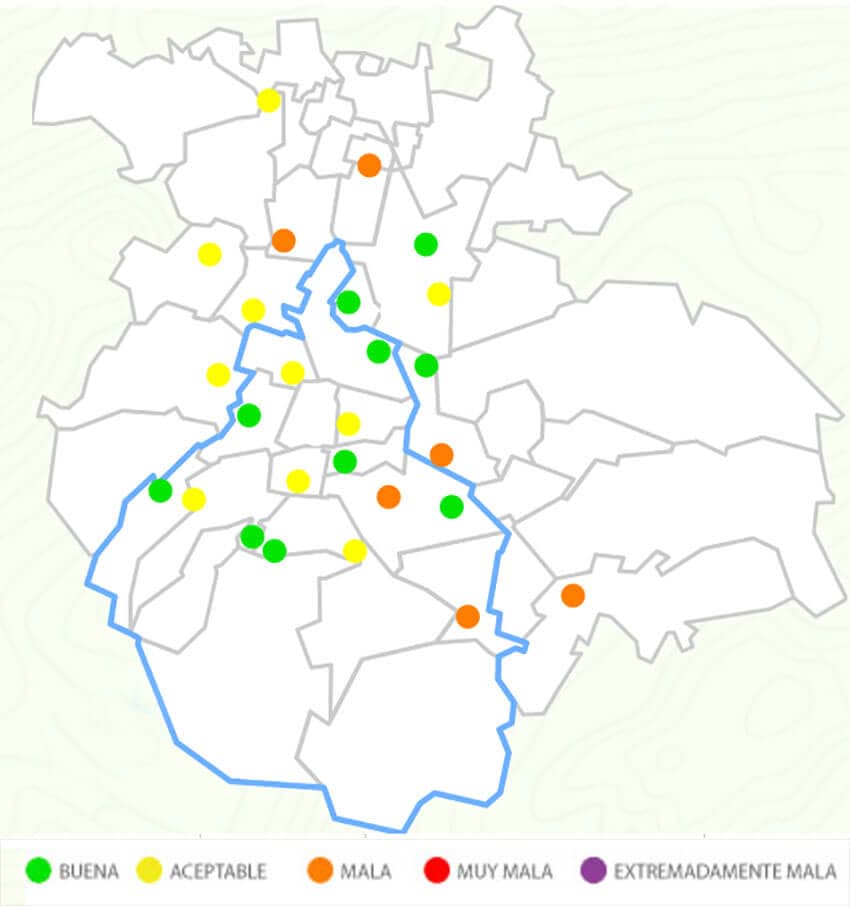
Air quality had improved significantly by 8 a.m. Friday, but the environmental alert remained in place. Air quality was “good” or “acceptable” at all monitoring stations in the greater Mexico City area with the exception of that in Chalco, México state, where the classification was “bad.”
Due to the reactivation of the alert, many vehicles are prohibited from using roads in the metropolitan area between 5 a.m. and 10 p.m. Friday. Among the banned vehicles are a large number of those with license plates that end in 1, 3, 5, 7, 9 and 0. Hybrid and electric vehicles are exempt from the restrictions.

Despite the improvement in air quality on Friday morning, authorities are still advising residents of the metropolitan area to avoid outdoor activities including exercise between 1 p.m. and 7 p.m. due to health risks associated with exposure to polluted air.
Mexico News Daily