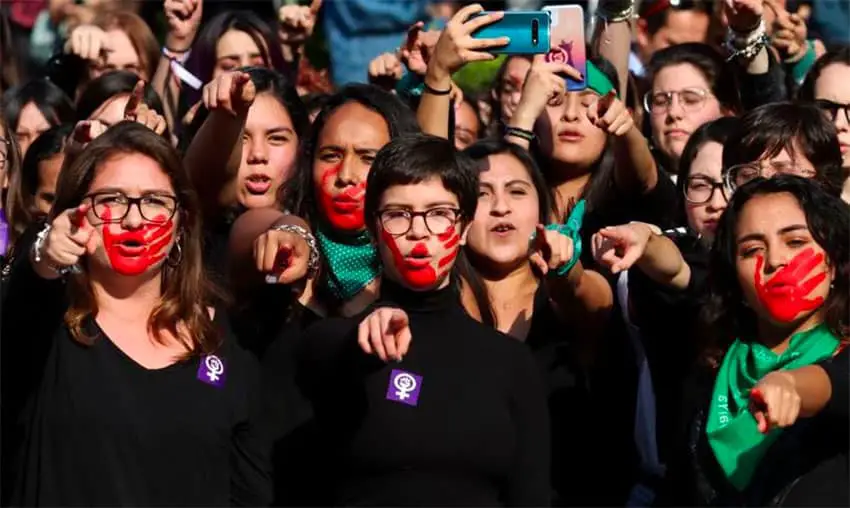
An estimated 36.4 million women are expected to join the national women’s strike next Monday, based on the support the movement has received from schools, businesses, the media and government departments.
The strike was triggered by growing violence against women, which came to a head last month with the gruesome murders of a 7-year-old girl and a 25-year-old woman. Femicides have more than doubled in the past five years.
The biggest educational establishments to join the strike movement are the National Autonomous University, the Metropolitan Autonomous University and the National Polytechnic Institute. The three institutions combined count 282,117 female students.
Private universities like the Ibero-American, La Salle, Anáhuac, Pan-American, Del Valle, Monterrey Tech and the Autonomous Technological Institute of Mexico have also expressed their support for the strike.
The estimate also takes into account the 13.1 million girls enrolled in the nation’s pre-school to secondary schools, both public and private, as well as the 1.2 million female teachers in those schools.
If all female teachers and students in Mexico’s educational system were to join in the women’s strike, the movement promoted by the hashtag #UnDíaSinNosotras (A Day Without Us), would see 16.6 million participants from the nation’s classrooms alone.
The country’s private businesses and public agencies will potentially provide another 22,032,000 women to the demonstration, a number representing 40% of the nation’s labor force.

A total of 9.4 million women are expected to join the strike from supporting companies like Walmart, Grupo Gigante, Coca-Cola and Bimbo.
Firms like Google, Bayer, Gandhi Bookstores, Sephora, Smart Fit, Chopo Medical Laboratories, Mercado Libre, Lenovo, Cabify, Petco, Devlyn, Warner Music, Grupo La Moderna and others have also shown their support.
Banks such as Banorte, BBVA, HSBC, Banco Azteca, Santander, Scotiabank, Citibanamex, Mifel and BanBajío have also joined the movement by giving their female employees the day off.
A number of federal, state and municipal government agencies have announced on social media that they support the national strike. A national survey by the federal statistics agency Inegi estimates that there are 2,878,000 women working in public institutions across the country.
The ministries of the Interior, Health, Culture, Economy, Environment and Natural Resources, Defense, Treasury and others have all expressed their support for the demonstration.
Among the high-profile supporters is Irene Espinosa, the only deputy governor at the Bank of México. “The numbers on violence against women are too high,” said Espinosa last week. “They’re unacceptable and we’ve normalized it.”
In addition to participants from the educational, public and private sectors, an estimated 8.8 million women dedicated to running their households are expected to join the strike and leave it up to their husbands to make sure their homes run smoothly next Monday.
In total, the national women’s strike has the support of 60 universities, 42 private companies, 21 state governments, 13 government agencies, 12 autonomous entities, 11 banks, seven non-governmental organizations and two political parties.