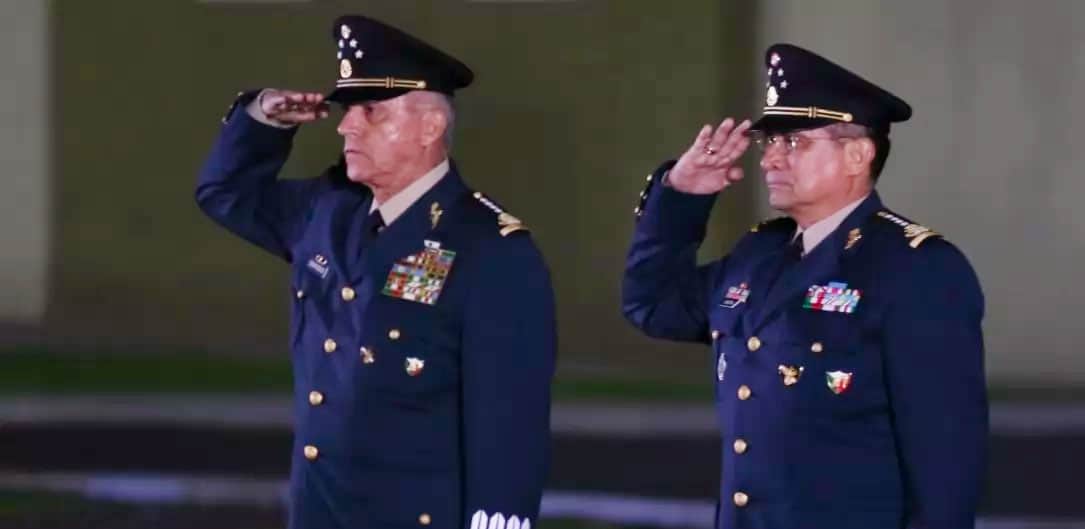
Former defense minister Salvador Cienfuegos, arrested on drug trafficking and money laundering charges in the United States last October but exonerated in Mexico last week, remains employed by the federal government as a military advisor.
Cienfuegos’ six-year term as army chief ended on December 1, 2018 – the day former president Enrique Peña Nieto left office and President López Obrador was sworn in – but he immediately became an elite advisor to current Defense Minister Luis Cresencio Sandoval.
The newspaper El Financiero reported that documents in the file that the federal Attorney General’s Office (FGR) opened to investigate Cienfuegos, who returned to Mexico in November after the United States dropped its charges against him, confirm that the former defense minister at no time ceased to be an advisor to Sandoval.
His designation as an advisor is consistent with three articles in the constitution, El Financiero said, adding that it was told by military sources that his appointment is also consistent with a presidential decree issued by former president Luis Echevvería in 1976. It is unclear how much the retired general is paid for advising his successor.
Documents in the FGR file on Cienfuegos also reveal that the government paid for his legal defense in Mexico. Lawyers who work for the Ministry of National Defense were assigned to represent the former army chief in his dealings with the FGR.
The Attorney General’s Office exonerated Cienfuegos less than two months after he returned to Mexico, raising questions about the thoroughness of its investigation.
The United States, which in a surprise move agreed to drop its charges against him while under pressure to do so from Mexico, alleged that as defense minister the ex-general colluded with the H-2 Cartel to smuggle large quantities of drugs.

United States authorities provided Mexico with the evidence it collected against Cienfuegos but the FGR concluded he never met with or colluded with the Nayarit-based cartel as the U.S. claimed.
López Obrador accused the Drug Enforcement Administration of fabricating evidence against the former defense minister and lacking professionalism. He said Monday that his government won’t remain silent in light of an “irresponsible” United States’ investigation into Cienfuegos but claimed that the matter won’t have a negative impact on bilateral relations.
Source: El Financiero (sp)