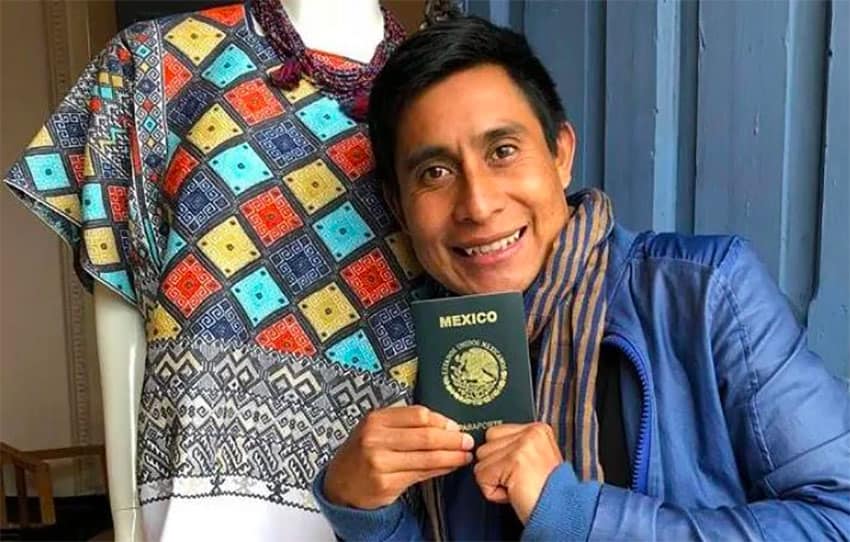
It is not easy to buck tradition. The Los Altos region of Chiapas is Maya country where most people live in rural and traditional communities where the roles of men and woman are strongly delineated.
This is the case in the small Tzotzil community of Aldama, located in the municipality of Magdalenas. Here, weaving is strictly women’s work, with men toiling in the fields. At least that used to be the case.
In 2014, Alberto López Gómez decided to challenge traditional thinking. He was 25 and until that point had followed his culture’s expectations. But then he decided to change his life.
“It took me a while to tell my mother that I wanted to learn to work on a backstrap loom. She was surprised because no man had ever done this, but she supported me from the first moment,” López told the newspaper El Universal.
That initial support was not widespread. He had to deal with disapproving stares and being told over and over that his place was the fields. “They criticized me because they did not want to see a man weaving. But I tried not to listen.”
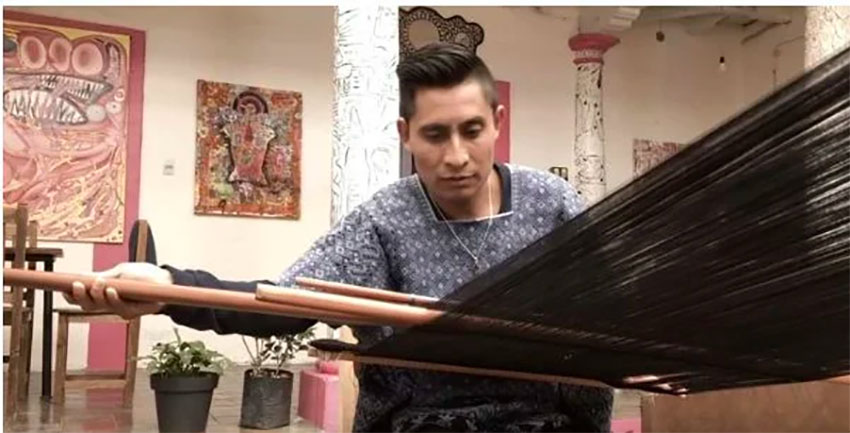
Every day at 6:00am he got up to weave for as many as 14 hours at a time, allowing him to hone his technique. Later he moved to tourist destination of San Cristóbal de las Casas where he established his own business. Here, over 130 Tzotzil artisans bring their textiles where they can get fair prices and be treated with respect.
Six years later, his talent and perseverance have paid off. López is slated to present his work and that of his community at Harvard University and New York’s prestigious Fashion Week. At the end of January he will travel to Boston to give a talk about the cosmology found on traditional Tzotzil huipils, the square or rectangular garments common in central and southern Mexico and are often highly decorated with woven and/or embroidered patterns. These designs are linked to the traditional beliefs and customs of a location.

At the beginning of February, the farmworker turned weaver will present as a designer a line called K’uxul Pok, which he has created along with 150 women weavers from his region. He considers this event an important opportunity to promote the traditional textiles of his region in the world of fashion.
The invitation came after a video created by a human rights network went viral online. Both Harvard and Fashion Week are covering López’s travel expenses.
The work is seen as being important because violence has increased in the area in the last three years, and promoting the work of someone like López encourages people to be proud of their region. In an interview, Adriana Pavón, a fashion consultant with ties in both the U.S. and Mexico, finds it interesting that it is foreigners who take a greater interest in and have a greater appreciation for traditional Mexican handcrafts.
“. . . unfortunately, in Mexico we have not yet taken the our cultural and intellectual talent seriously. It is important to create binational (U.S.-Mexico) ties with the aim of supporting and growing our local talent.”
López, meanwhile, not only weaves and sells huipils, he further defies conventions by wearing them as well.
He continues to work against the notion that weaving (and other textile work) belongs only to women. In a recent post to his Facebook page he stated that “My goal is to let people know about my work and the work of my associates, even though people sometimes are envious or critical. I learn much being able to give my associates encouragement.”
Source: Megamedia (sp), El Universal (sp)