Ford is facing potential parts shortages from suppliers in northern Mexico as the coronavirus pandemic throttles production, threatening the ability of factories in the United States to keep manufacturing vehicles.
The governor of the state of Chihuahua, an important region supplying the U.S. automotive industry, has barred employers from operating with more than half their workforce in an attempt to control the spread of Covid-19.
“Due to Covid-19, the state of Chihuahua in Mexico has limited employee attendance to 50%, a region in which we have several suppliers,” Kumar Galhotra, president of Ford’s Americas and International Markets Group, said in a statement. “With our U.S. plants running at 100%, that is not sustainable. While we do not expect any impact to production next week, we are continuing to work with government officials on ways to safely and constructively resume remaining production.”
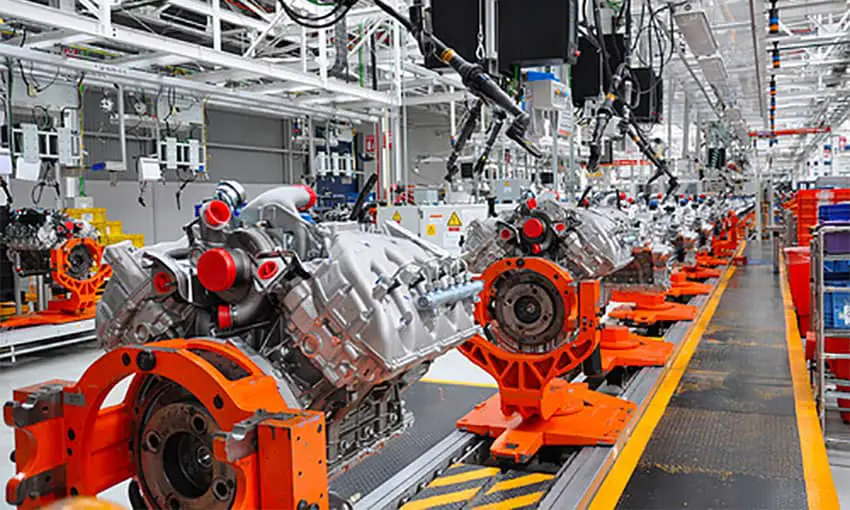
Besides suppliers, Ford operates an engine plant in Chihuahua where 2,400 workers make engines for its larger F-series trucks and the Escape crossover utility vehicle.
Christopher Landau, the U.S. ambassador to Mexico who has a reputation for speaking candidly, told an Atlantic Council webinar on Thursday that Ford was struggling to deal with capacity constraints at the engine plant.
“Last night at the dinner I was talking to one of the senior executives from the Ford Motor Company,” he said. “They were saying they are going to have to start shutting down their factories in the United States as of next week if they don’t get that rolling.”
The dinner he referred to was at the White House during Mexican President López Obrador’s visit to Washington.

Óscar Albín, president of the National Autoparts Industry, said that while he had not heard about Ford’s problem specifically, in Chihuahua “many car parts are not being produced to the needs of the car factories in the U.S. and Mexico. In June, production was sufficient because the car factories were not working at 100% either, but in July the [car] factories are at 100%.”
Asked if there could be shortages, Albín added: “It’s not that there could be, there are. And not just Ford, all the factories in the U.S.”
Luis Carlos Ramirez, Chihuahua president of Index, which represent manufacture-for-export industries, said Ford had started at 30% capacity at the start of June, when the automotive industry was designated essential.
At that time, under Mexico’s stoplight system, which governs the gradual reopening of the economy according to the spread of the virus, Chihuahua was on red, but two weeks ago it moved to orange and increased to 50%.
“We hope we will soon change to yellow and be on 80%,” Ramirez said.
The only surprise in a carmaker experiencing supply chain problems in Mexico because of the pandemic was that it had not happened sooner, said Kristin Dziczek, vice president of industry, labour and economics at the Center for Automotive Research in Michigan.
She said trouble at the Chihuahua engine plant would be particularly painful because while all vehicle sales are down — Ford’s U.S. sales plunged 33% in the second quarter — demand for trucks had been more resilient. Furthermore, trucks were more profitable.
© 2020 The Financial Times Ltd. All rights reserved. Please do not copy and paste FT articles and redistribute by email or post to the web.