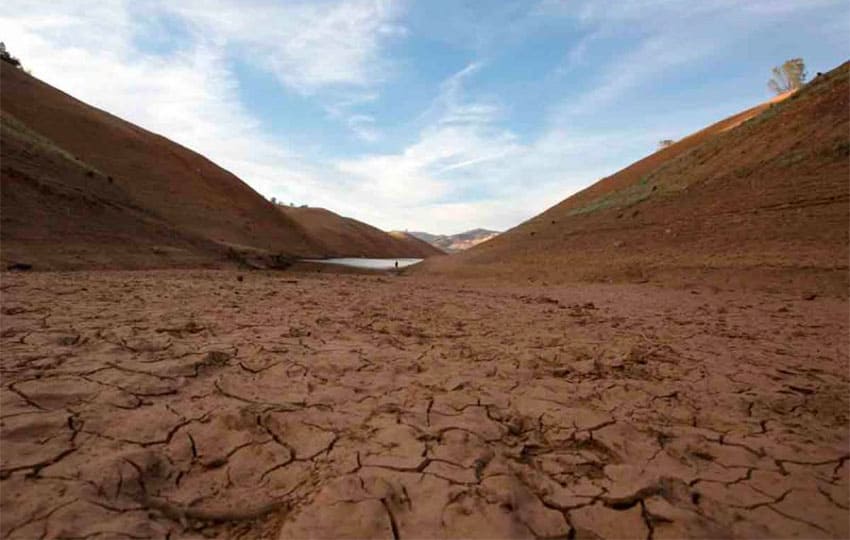
President López Obrador is determined to achieve food self-sufficiency but imports of key grains actually increased in the first five months of the year as drought ravaged crops in Mexico.
Imports of a range of grains including corn, wheat and rice increased 13.6% between January and May compared to the same period of last year, according to the secretary general of the National Union of Agricultural Workers (UNTA).
Speaking at a meeting of the UNTA leadership council, Álvaro López Ríos said that Mexico is in fact getting farther away from self-sufficiency for basic grains because imports have been on the rise for three years.
He said they totaled 16.73 million tonnes in the first five months of the year, costing US $6.29 billion. Grain production in Mexico fell 2.8% in the same period but demand rose 8.1%, López said.
He criticized the government for cutting funding for the agricultural sector by 40% over three years and eliminating at least 30 financial support programs for farmers, even though López Obrador – who has said on repeated occasions that he wants to wean Mexico off imports of basic foods – pledged to increase support for the countryside.
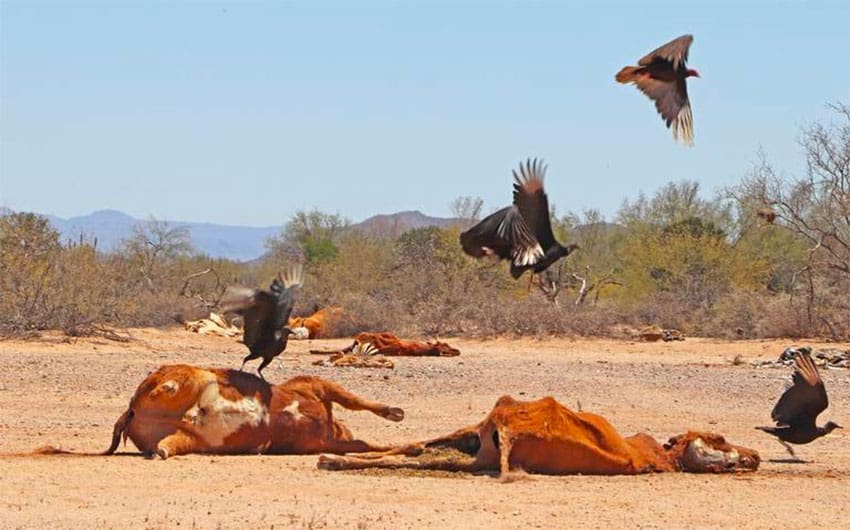
Drought has also dealt a heavy blow to Mexican farmers. Some 361,000 hectares of crops were damaged by drought in the first five months of the year and approximately 1 million head of cattle died, according to data presented at a forum this week on the drought and its impact on agriculture. The former figure represents a 365% increase compared to the same period of 2020.
The main crops affected were corn, wheat, rice, beans and sorghum, according to experts who participated in the forum organized by Bayer México.

Luis Fernando Haro, director general of the National Agricultural Council, said drought has caused delays in the harvest of crops and environmental damage, and reduced farmers’ incomes. The management of water has to improve in order for the country to be better prepared for future droughts, he said, advocating the use of drip irrigation systems and improved seeds that are more resistant to water scarcity.
Drought has affected more than 80% of Mexico’s territory since the middle of last year and there are fears that conditions could worsen in some parts of the country in coming weeks as temperatures rise. Additional crop damage and water shortages are among the problems predicted by experts.
“In some states, irrigation is practically disappearing due to lack of precipitation,” Rafael Sánchez Bravo, a water expert at Chapingo Autonomous University in México state, told the news agency Reuters.
Breaking the drought in many parts of the country is contingent on precipitation levels during the rainy season, when many regions get 50% to 80% of their annual rainfall.
“The next three months will be really crucial in how this drought turns out,” Andreas Prein, an atmospheric scientist for the National Center for Atmospheric Research in Boulder, Colorado, told Reuters.
Some experts predict that greater Mexico City, where water supply is already an issue in some areas, will soon experience a severe shortage.
“I have no doubt that in 2022 there will be a crisis,” Sánchez said, adding that a lack of water will likely cause social unrest. “The reservoirs are completely depleted.”
Water supply in other parts of the country could also be at risk as 77 of 210 of Mexico’s main water dams were below 25% capacity at the end of June, according to the National Water Commission. Only 56 reservoirs were below that capacity a year ago while two years ago the figure was 40.
The air force has taken to seeding clouds in an effort to combat the prolonged drought – which many experts believe is a product of climate change – but there is no guarantee that its efforts will make a substantial difference.
Meanwhile, Mexico’s 2021 corn production target of 28 million tonnes remains at risk, Reuters reported.
“The scenario is pessimistic and we can’t deny we’re worried,” a senior Agriculture Ministry official told the news agency.