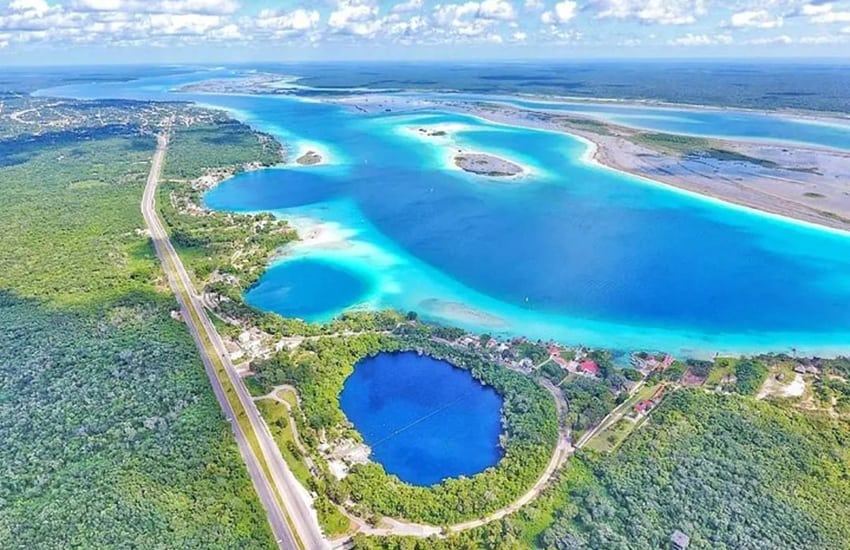
Several business groups and local landowners have warned that they won’t allow the creation of a natural protected area (ANP) in the Bacalar lagoon area of Quintana Roo.
Groups that include the Bacalar chapter of the Mexican Employers Federation and the southern Quintana Roo branch of the Business Coordinating Council (CCE) as well as owners of land in the municipalities of Bacalar and Othón P. Blanco held a press conference this week to express their opposition to the designation.
They argued that there are already legal instruments to regulate “sustainable rustic growth” in the Bacalar lagoon region, an area popular with tourists located about 40 kilometers northwest of Chetumal.
The press conference came after the Quintana Roo ministries of Tourism and the Environment made the decision to fund a tourism management program for the Bacalar lagoon area, a move seen as a step toward an ANP designation, which would severely limit or prohibit further development.
The business groups and landowners claimed that the Amigos de Sian Ka’an, an environmental, conservation and sustainable development NGO, and other environmental groups have “bought” scientific opinions to support the creation of a new ANP.
Eloy Quintal Jiménez, the local president of the CCE, said the environmental organizations that are pushing for the designation on the grounds that there are high levels of pollution due to tourism did the same thing in 2017 because “they want to control the lagoon and generate economic resources for their own benefit.”
“The most offensive thing is that these people, outsiders mainly, are seeking to shut down investment opportunities and sources of employment, as has happened in Chilaquilá, Holbox, Xcalak and Felipe Carrillo Puerto,” he said, referring to other destinations in Quintana Roo.

Quintal also said the lagoon is recovering from recent pollution — which some people say was caused by runoff of rain rather than tourism — “in contrast to the forecast of those who promote the creation of an ANP.”
The business groups — among which are also the Bacalar Hotel Association, the Quintana Roo branch of the Mexican Chamber of the Construction Industry and the Chetumal-Tulum chapter of the Mexican Chamber of Commerce — and the landowners said they are committed to sustainable development but not in a way that benefits just a few people.
They argued that there are already environmental regulations to guide sustainable development and therefore an ANP designation is not needed.
They also called on mayoral candidates in Bacalar and Othón P. Blanco — adjoining municipalities across which the lagoon area is located — to commit to a comprehensive environmental and land-use agenda that protects the lagoon but allows the surrounding forested area to be used in a sustainable way.
Quintal noted that the state government reached an agreement with landowners and business groups in 2017 that there would be no ANP in the area.
Despite that, the government — led by Governor Carlos Joaquín since 2016 — has funded the tourism management project that could lead to an ANP, he said before reiterating that the business groups and landowners won’t allow it to happen.
Source: Noticaribe (sp), El Economista (sp)