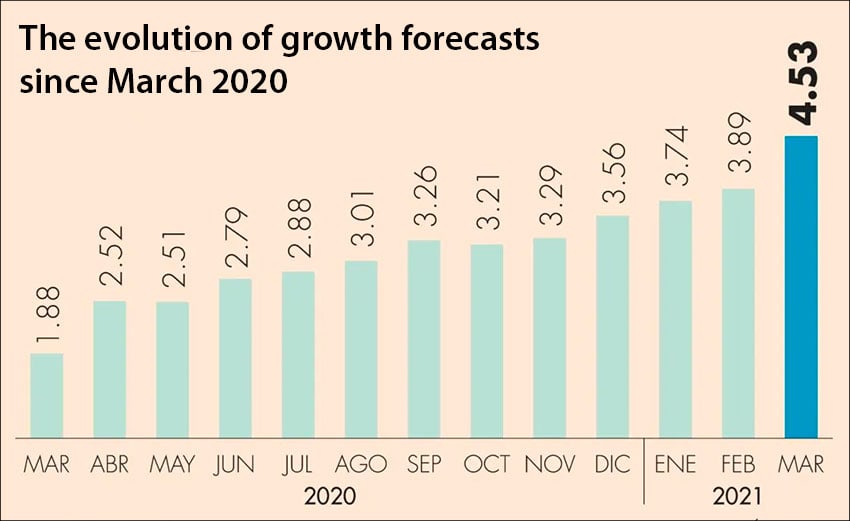
Both the International Monetary Fund (IMF) and private sector experts consulted by the Bank of México (Banxico) have revised their annual GDP forecasts upwards.
Analysts raised their growth expectations for Mexican GDP to 4.53% in 2021, up from their February prediction of 3.89%. This represents a fifth consecutive rise in monthly revisions.
The IMF expects Mexico’s economy to grow 5% this year, 0.7 points up on predictions made in January. For 2022 its World Economic Outlook (WEO) report projects a 3% increase in Mexico’s GDP, up 0.5% from its last report.
The bright forecasts for Mexico’s economy are part of a global trend with better growth predicted for advanced economies, principally that of the United States, where GDP is projected to grow at 6.4% in 2021 and 3.5% in 2022; a respective 1.3 and 1 point improvement on the IMF’s January forecasts.
After a contraction of 3.3% in 2020 global GDP is also expected to grow, with the IMF putting its global GDP forecast up 0.5 points to 6% for 2021 and 0.2 points for 2022, to 4.4%.
“The upgrades in global growth for 2021 and 2022 are mainly due to upgrades for advanced economies, particularly to a sizeable upgrade for the United States (1.3 percentage points) that is expected to grow at 6.4% this year. This makes the United States the only large economy projected to surpass the level of GDP it was forecast to have in 2022 in the absence of this pandemic. Other advanced economies, including the euro area, will also rebound this year but at a slower pace,” explained Gita Gopinath, director of the research department at the IMF.
However, she warned of overwhelming challenges ahead as the average annual loss in GDP per capita during the 2020-2024 period, relative to pre-pandemic forecasts, is projected to be 5.7% in low-income countries and 4.7% in emerging markets, while in advanced economies losses are expected to be less than 2.3%.

Those losses in GDP per capita are reversing poverty reduction. It is thought that an additional 95 million people joined the ranks of the extremely poor in 2020 compared to pre-pandemic projections.
“A high degree of uncertainty surrounds our projections. Faster progress with vaccinations can uplift the forecast, while a more prolonged pandemic with virus variants that evade vaccines can lead to a sharp downgrade,” wrote Gopinath in the IMF’s WEO blog.
Sources: El Economista (sp), El Financiero (sp)