The deployment of the National Guard doesn’t match Mexico’s security needs, according to two experts.
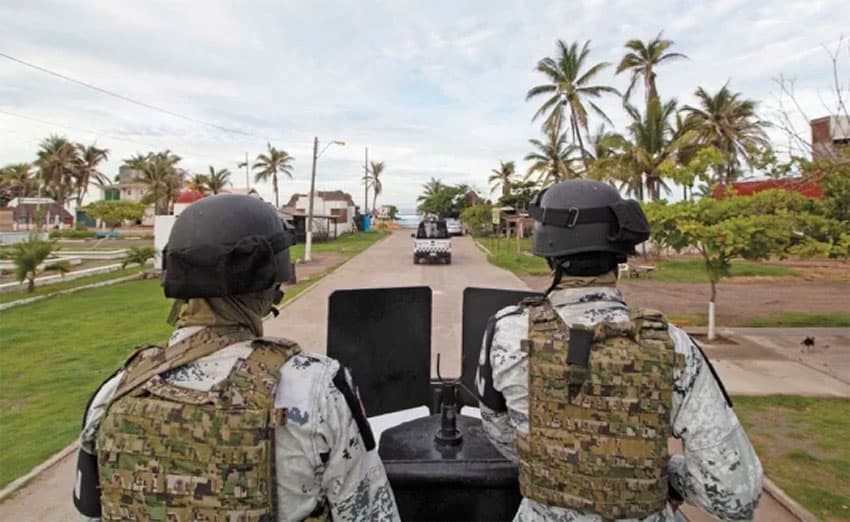
More than 56,000 members of the new security force have now been deployed to 150 regions across the country. Just over 9,000 guardsmen are stationed in México state while more than 3,000 are deployed to each of Michoacán, Jalisco, Oaxaca and Mexico City.
But a report in the newspaper El Universal pointed out that in six other states – Zacatecas, Querétaro, Yucatán, Campeche, Baja California Sur and Tlaxcala – the number of National Guard members is disproportionately high considering the number of homicides committed in those states so far this year.
Yucatán, for example, has 673 guardsmen but there have only been 18 murders, while Campeche has recorded 36 homicides but has 479 troops.
Querétaro, where there were 116 homicides between January and July, is home to more National Guard members than Tamaulipas, a state plagued by violence generated by the Gulf Cartel and the Zetas.
According to Ricardo Márquez Blas, a security expert and former high-ranking official in the National Security Commission, some of the guardsmen deployed to states with low or relatively low numbers of homicides should be sent to “other areas where the crime rate is higher” such as municipalities in Veracruz, Tamaulipas, Jalisco and Michoacán.
“There is no reason to standardize” deployment numbers because “the regions are different,” Márquez said. “An adjustment has to be made, a made-to-measure approach [is needed] for each case.”

The discrepancy between the areas where National Guard members are deployed and where they are needed is even more marked at a municipal level, El Universal said.
When the Jalisco New Generation Cartel attacked Tepalcatepec, Michoacán, in late August, there wasn’t a single guardsmen or member of the armed forces in the municipality even though the cartel gave prior warning of its plan in a video posted to social media.
Just over 1,000 National Guard troops were deployed to the southern Veracruz municipalities of Minatitlán, Coatzacoalcos and Cosoleacaque in April after 13 people were killed at a bar in Minatitlán but 770 were subsequently withdrawn, leaving just 289 guardsmen in the area when an attack on a Coatzacoalcos bar, which claimed the lives of 30 people, occurred late last month.
Security analyst Alejandro Hope agreed with Márquez that National Guard should not be deployed uniformly because different parts of the country have different security needs.
Sending troops to Yucatán, Campeche and Querétaro is a “waste,” Hope said, charging that they should be in states such as Michoacán, Jalisco, Guanajuato and Veracruz, where turf wars between rival crime groups have caused violent crime rates to surge.
“This scheme will have no effect in reducing violence . . . The National Guard is not where the homicides are [happening],” he said.
“There’s no logic in the deployment, all of the regional contingents are going to have the same number of elements [500] and I don’t believe that the same number is needed everywhere,” Hope added.
The security analyst contended that “institutional inertia” is guiding the government’s deployment of the National Guard, explaining that guardsmen are being sent to locations where there are existing facilities from which they can work and in which they can be housed.
Hope also claimed that the National Guard – an “intermediate security force between the police and the armed forces” – is not designed to combat violent crime.
“Normally [such a force] is used for territorial control purposes [and] is mainly deployed to rural areas and small towns,” he said.
Source: El Universal (sp)