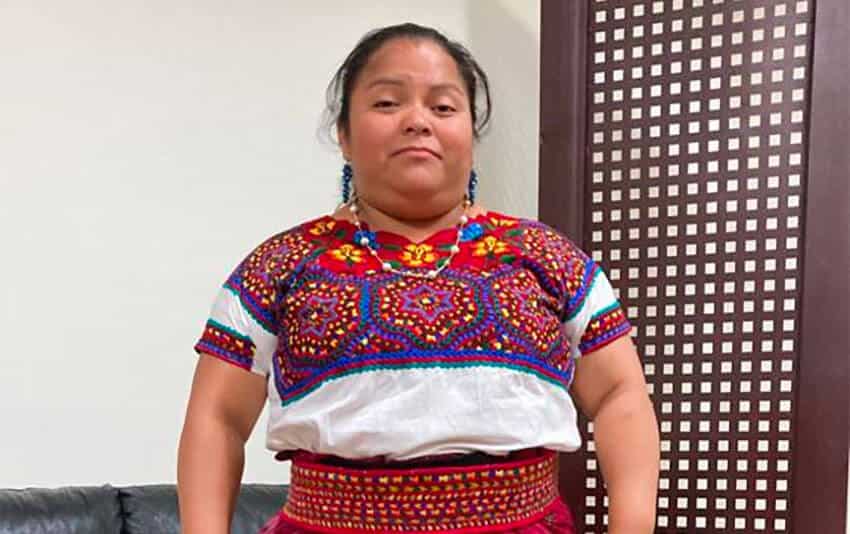
An indigenous Guatemalan migrant who was imprisoned in Mexico for more than seven years without a trial was freed last weekend.
Juana Alonzo Santizo, a Mayan Chuj woman, was jailed in 2014 after she was arrested in Reynosa, Tamaulipas, on kidnapping charges.
A court ordered her immediate release last Saturday and she returned to Guatemala on Sunday.
Netzaí Sandoval, head of Mexico’s federal public defenders office, said the court found that there was no consistent evidence against Alonzo, who left the Guatemalan town of San Mateo Ixtatán in 2014 to migrate to the United States to find work.
Sandoval, whose office defended Alonzo, said the charges she faced were not translated into her native language of Chuj until this year. The 35-year-old didn’t speak Spanish when she was detained, but learned the language during her lengthy stay in pre-trial detention.
Sandoval also said that Alonzo was tortured and forced to sign a confession she didn’t understand.
Her release comes after a campaign for her freedom that was supported by her family, her community in Guatemala, Mexican and international groups and President López Obrador. The Tamaulipas Attorney General’s Office eventually dropped the charges against her.

The Centro Prodh human rights organization, one of the groups that supported the “Freedom for Juanita” campaign, said the work of the media in documenting the case and in doing so “putting a face to this story of injustice” played an important role in obtaining justice for Alonzo.
It also said the United Nations played an important role by confirming “the abuses committed against this honorable indigenous woman and migrant.”
Abuses against migrants traveling through Mexico are common, with authorities and criminal organizations among the perpetrators. But migrants are far more likely to face deportation than imprisonment for years on fabricated charges.
Sandoval described Alonzo’s case as “totally aberrant,” asserting that her rights were violated because she is a woman, an indigenous person, a migrant, poor and didn’t know Spanish.
The Associated Press reported that an emotional Alonzo was met at the Guatemala City airport by her family last Sunday. After collapsing into her father’s and uncle’s arms, she changed into traditional Mayan Chuj clothes, AP said.
“It is easy to go to prison, but it is difficult to get out of it,” Alonzo said in hesitant Spanish.
“Her crime was being unable to speaking Spanish,” said her uncle, Pedro Alonzo. “Who is going to pay for that scar?”
There are thousands of people in Mexico’s prisons who have never been convicted of a crime. Official statistics show that over 40% of the prison population is made up of people who have not been convicted or sentenced.
One person determined to put an end to the common practice of incarcerating people for months or years before they face trial is Supreme Court Chief Justice Arturo Zaldívar, who said earlier this month that there has been an “abuse” of preventative prison in Mexico.
With reports from AP