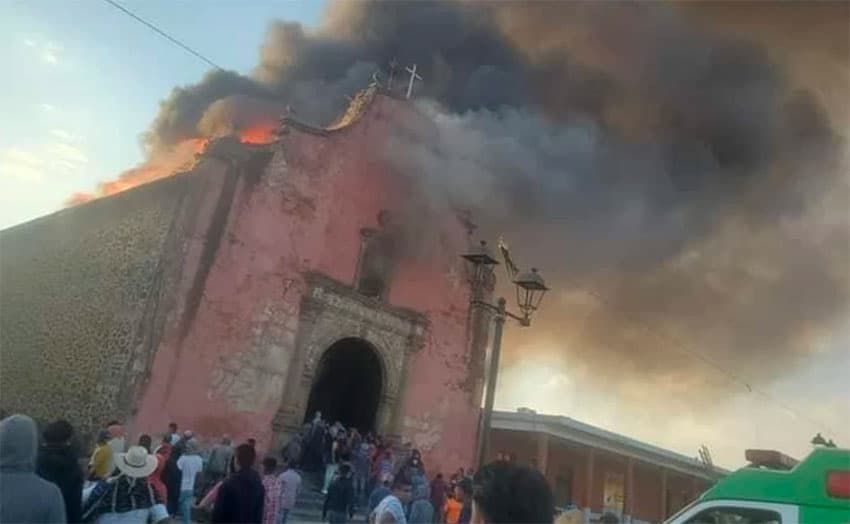
A historic 17th-century church built by Spanish missionaries in one of Michoacán’s original indigenous Purhépecha areas was destroyed by fire Sunday afternoon.
Emergency officials said they don’t yet know what caused the fire at St. James the Apostle Church in the town of Nurio. Residents noticed around 6 p.m. that the church’s wooden roof and its inclined support beams were in flames.
Residents attempted to put out the conflagration but it had already consumed a large part of the roof and by the time firefighters arrived from Paracho and Uruapan the church was severely damaged.
According to the newspaper Monitor Expresso, a lack of available water to fight the fire, as well as fire hoses that did not extend more than 20 meters and were themselves highly flammable hampered firefighters’ efforts.
The National Institute of Anthropology and History (INAH) is investigating the extent of the damage but media accounts indicate that while the exterior walls are still standing, nothing remains of the roof and the interior.
Incendio destruye arte sacro invaluable en la Iglesia de Santiago Apóstol de Nurio, perteneciente al municipio de Paracho, ardió en llamas.#Nurio #Paracho #Michoacan #TemploSantiagoApostol pic.twitter.com/NUsAEcsDhh
— Orgullo Purepecha (@OrgulloPurepech) March 8, 2021

Federal Culture Secretary Alejandra Frausto described the church, which dates back to 1639, as “one of the most beautiful churches in the world.”
The Archdiocese of Morelia called it “an architectural jewel of incalculable value.”
Constructed of painted stone with an imposing entrance featuring a cut stone porch and Corinthian columns, the church was built in the Mudejar style, a Gothic architectural design with Islamic influences that was prevalent in Spain from the 12th to the 15th century.
Over time, features of the outer construction were replaced with masonry, but much of the church’s inner construction was done by local woodworkers.
The church featured intricate religious paintings and sculpture on its walls and ceilings dating back centuries. Its choir, according to Monitor Expresso, was one of only two with its distinct architectural style in the world; the only other is located in a historic church in South America.
The church was a central feature of Nurio’s religious and public life, with many holy days and Catholic saints’ feast days celebrated there, including that of St. James, the town’s patron.
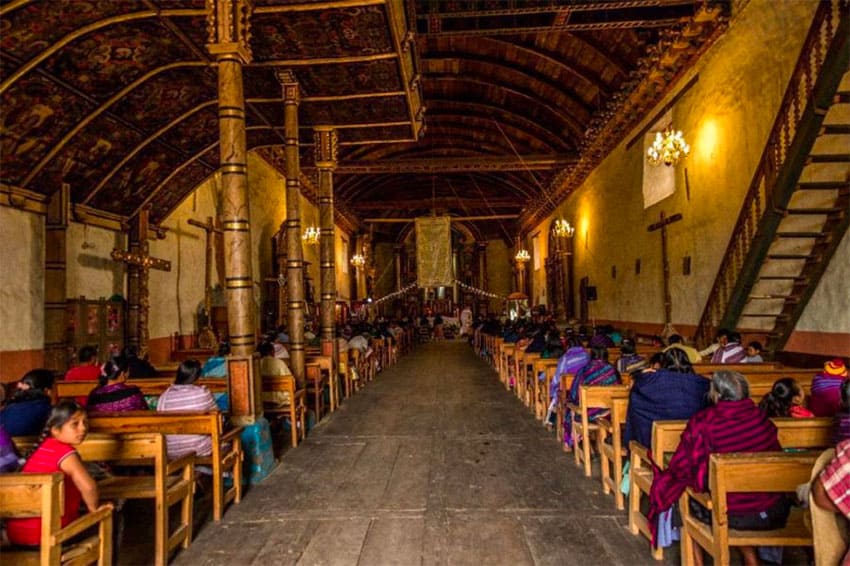
It had survived at least two previous fires; one in the 1980s took out some of the church nave’s historic painted ceiling panels. Another fire in 2015 damaged its vault.
Sources: El Universal (sp), Monitor Expresso (sp)