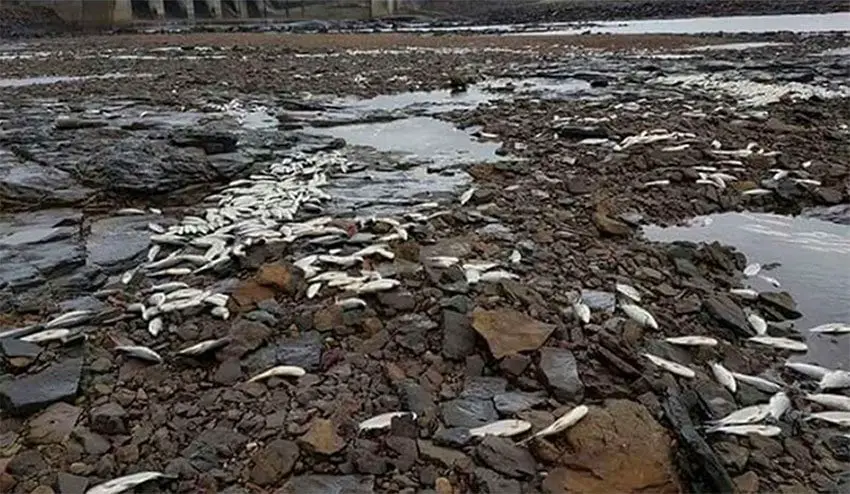
A large lagoon in Juchitán, Oaxaca, has been flooded with sewage after a failing drainage system forced residents of one neighborhood to take matters into their own hands.
Around 35,000 hectares of Laguna Superior have been affected by a deluge of untreated wastewater that is currently being pumped into the lagoon, killing fish and leaving businesses on the shoreline without customers.
Raw sewage began flowing into the lagoon around the middle of last week after residents of the Lorenza Santiago neighborhood modified the drainage system.
Community leader Javier Sánchez Orozco told the news agency EFE that people were forced to act because sewage was seeping out of the drains in their homes.
“We decided to call a meeting because people couldn’t put up with it anymore . . . We decided to open up the drainage [system] and install a six-inch pipe to drain the sewage,” he said.
Residents are now depositing wastewater into the open drainage system before it is transported directly to the lagoon. A recent lack of rain has caused a normally submerged sandbar to emerge, cutting the lagoon off from the Pacific Ocean and exacerbating the contamination problem.
“We know that we’re harming the lagoon but what can we do,” Sánchez said. “We couldn’t wait any longer. The population grew and the city’s drainage network collapsed.”

Rubén Dario Hernández, director of public works on the Juchitán council, said the city’s drainage has experienced problems since the powerful earthquake in September 2017 that ravaged towns in the Isthmus of Tehuantepec region.
He explained that Juchitán’s only wastewater treatment plant hasn’t been operational for seven years, adding that at least seven other municipalities in the region pump raw sewage into the Los Perros river, which flows into Laguna Superior.
“We’re currently working on a project . . . to repair the wastewater treatment plant and to build two more so that the wastewater that is dumped into the Los Perros river is treated beforehand, but that will take time,” Hernández said.
For residents of Playa Vicente, a community on the shore of the polluted lagoon, a solution to the current problem can’t come soon enough. They are currently suffering from the fetid odors of the sewage, and urging municipal, state and federal authorities to take action to remedy the situation.
Irving Jiménez, a worker in a beachside restaurant, told EFE that the lagoon stench is also keeping customers away.
“. . . There are no sales nor will there be any until they find a solution to this problem . . . The lagoon is going to die; we hope that they [the authorities] turn around and see what is happening in our town.”
Source: EFE (sp)