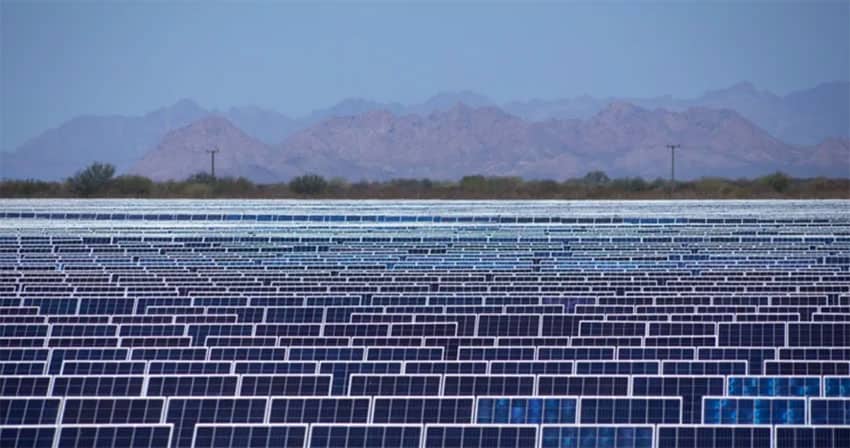
A federal judge has ordered the provisional suspension of the new Electricity Industry Law, ruling that it could harm free competition and cause irreparable damage to the environment because it favors traditional energy sources over renewable ones.
Judge Juan Pablo Gómez Fierro made the ruling Thursday in response to suspension requests filed by renewable energy companies.
A reform to the law that favors the state-owned Federal Electricity Commission by prioritizing the injection of power it produces into the national grid over that generated by private and renewable companies was approved by Congress last week.
President López Obrador promulgated the law by decree on Tuesday and it took effect Wednesday.
Julio Valle, spokesman for the wind and solar power associations Amdee and Asolmex, said more than two dozen proposed injunctions had been filed as the industry united in opposition to the law.
“We’re happy, but this is just the first battle,” Valle said. The provisional ruling could still be struck down and the law is expected to face further constitutional challenges.
“I think here the big question is what happens when this gets to the Supreme Court,” said Lourdes Melgar, a deputy minister of energy at the time of the landmark energy reforms in 2013-2014.

“Given all the precedents at play here, it’s not really surprising that injunctions were granted less than 48 hours after the ‘reform’ was published,” said Pablo Zárate, managing director at FTI Consulting.
The president’s office did not immediately reply to a request for comment, and companies were treading cautiously, the Financial Times reported. “We don’t want to inflame a confrontation because our president then just gets more obstinate,” said one senior player in the sector who asked not to be named.
The federal judge ordered that the law in force before the publication of Tuesday’s decree be reapplied. That law, which stemmed from the previous government’s energy reform, guaranteed free competition in the electricity sector, sustainable development and protection of the environment whereas its successor does not, Gómez said.
“This district court warns that the modifications made to the Electricity Industry Law could damage free competition in the electricity sector,” he said.

The judge said suspension of the new law would result in more competitive electricity prices for consumers – private companies generate energy at a much lower price than the CFE – and allow Mexico to meet its goals for the generation of clean and sustainable energy.
Gómez said the government’s modifications and additions to the law “move away from the objectives of the energy reform and are thus apparently contrary to articles 25 and 28 of the constitution.” Article 28 states that all monopolies are prohibited in Mexico.
“… On the other hand, it is deemed that the rules that have been challenged could produce imminent and irreparable damage to the environment because they promote the production and use of conventional energies and disincentivize the production of clean energies, ” the judge said.
He also said the new law could prevent Mexico from meeting international environment and climate commitments given that it prioritizes energy produced by the CFE, which mainly uses natural gas, coal and fuel oil to generate power, over private companies’ renewable energy.
The court will rule next Thursday whether the order will become definitive. A constitutional hearing on the case has been set for April 27.
That the government’s electricity reform was challenged so soon after it was approved was not surprising given that private and renewable companies have already challenged other moves by the government to concentrate control of the electricity sector in the hands of the CFE.
President López Obrador, a staunch energy nationalist determined to “rescue” the CFE and state oil company Pemex from what he describes as years of neglect and mismanagement before he took office, insisted last week that the new law doesn’t violate the constitution.
But many legal experts say otherwise. Lawyers also say that it violates the new North American free trade agreement and international trade treaties.
The International Chamber of Commerce’s Mexico chapter said Wednesday that it expects the law to trigger a flood of lawsuits, legal appeals and and international investor-dispute arbitration panels. The chamber said that provisions in the law violate the constitution, which enshrines the right to free competition and a healthy environment.
Several analysts have said that the law will scare off foreign and domestic investment because of the privileged position it grants the CFE in the electricity market.
Source: Milenio (sp), Sin Embargo (sp), Financial Times (en)