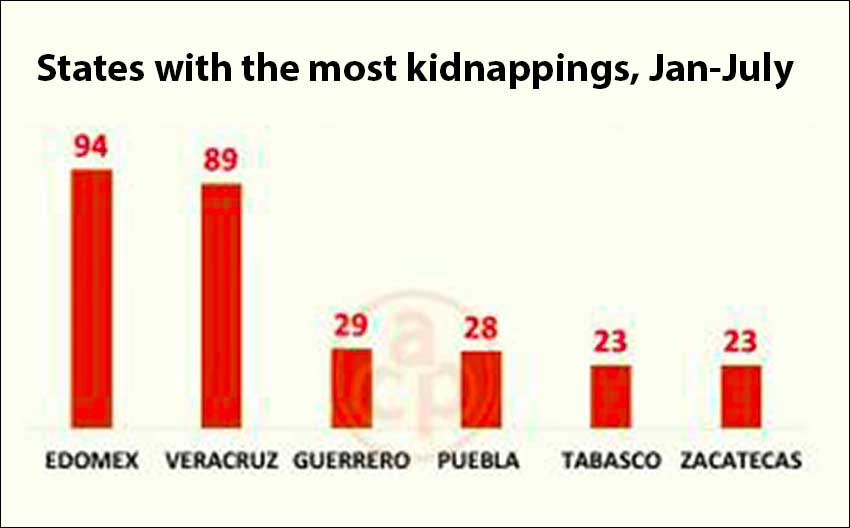
There is one good piece of news this week in a security situation that has steadily worsened for three years or more.
Kidnappings declined by 16% in the first seven months of 2018 compared to the same period last year, the Interior Secretariat (Segob) reported yesterday.
The federal department said in a statement that authorities opened 735 new files for the crime between January and July, 142 fewer than the 877 files opened between January 1 and July 31 last year.
“The coordinated work between institutions, the exchange of information, the actions surrounding the prevention campaigns and their dissemination, as well as the participation of citizens through the reporting of cases, are factors that have allowed the federal government and the states to maintain the downward trend in the kidnapping rate,” Segob said.
It also reported that preliminary statistics from the National Public Security System (SNSP) showed that state-based prosecutors’ offices opened 83 new cases of presumed kidnappings last month, while the federal Attorney General’s office (PGR) said it had initiated 28 investigations.
The total number of 111 new cases is 5.12% less than the 117 reported in July last year.
Nine states — Aguascalientes, Baja California Sur, Campeche, Chiapas, Coahuila, Durango, Guanajuato, Sonora and Yucatán — had no reports of kidnappings last month, Segob said.

The department also said that a meeting of the eastern region’s specialized anti-kidnapping units (UECS) had taken place in Querétaro, at which a range of objectives were analyzed, including ones related to the training of squad members, criminal investigations, victim recovery and attention to victims and their families.
Five other UECS regional groups will also hold meetings this month in Nuevo León, Sonora, Tabasco, Mexico City and Guerrero, Segob said.
“The government of the republic maintains its commitment to work in a coordinated manner with all states . . . and renews its call to citizens to report this crime with the anti-kidnapping unit of their state or on the number 911 . . .” the statement said.
Despite the decline in kidnappings in the first seven months of the year, the number of cases recorded during the administration of President Enrique Peña Nieto — now more than 7,000 — is the highest ever registered in a six-year presidential term.
Figures released earlier this year showed that Tamaulipas has been the worst affected state since Peña Nieto took office in December 2012, followed by México state, Veracruz, Guerrero and Tabasco.
Segob said in June that there are now 37,435 missing persons in Mexico, 40% more than the number reported in 2014.
In November last year, Peña Nieto promulgated a new law designed to better fund and improve search efforts for the thousands of people reported as missing or forcibly disappeared.
Source: Quadratín (sp) El Universal (sp)