Monday, February 23, 2026

Latin America’s largest cargo ferry to operate in Gulf of California

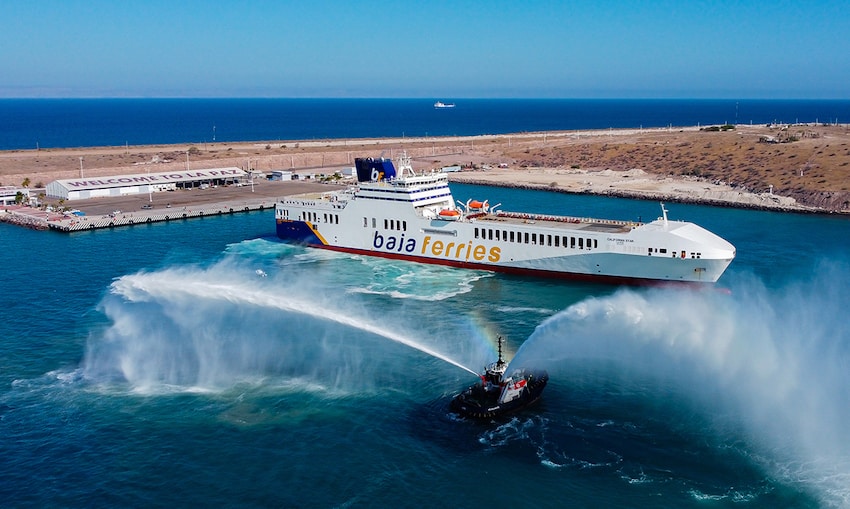
The California Star, the largest ferry and cargo vessel in Latin America, has arrived in Mexico and will shortly begin operations between Sinaloa and Baja California for the local Baja Ferries group. 

The ship arrived in the port of Pichilingue in La Paz, Baja California Sur (BCS), and measures more than 193 meters long, and 26 meters wide. Per trip, it has a capacity for 2,850 linear meters of cargo, a figure equivalent to 200 large vehicles. 
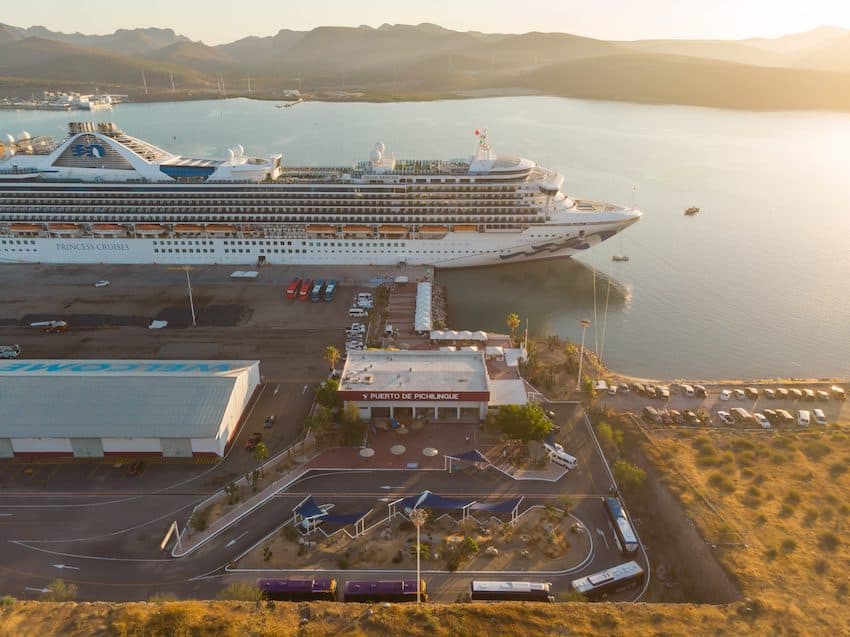
The pichilingue ferry terminal
The California Star is in the port of Pichilingue, outside La Paz, Baja California, before entering service in July. (Puerto Pichilingue)

The California Star also boasts 37 cabins, a VIP lounge and two restaurants, as well as a general seating area for a capacity of 400 passengers per trip. It’s designed to accommodate passengers with special mobility requirements.

“We are a socially responsible company, and with this, we are committed to being key players for the growth and development of the northwestern region of our country,” Ariel Pozo, CEO of Baja Ferries said. “The arrival of the California Star, a ship with the Mexican flag and crew, is proof of this. We continue to reinvest to ensure supply and growth for [BCS residents] for the coming years.” 

“We chose to name the new ship the California Star to reflect our commitment to the people of Baja California Sur, as we are a local company and are honored at the way people identify with our boats,” he continued. 

The ferry was built in 2009 as the Humber Viking, under the British Norfolk Line. Before arriving in Mexico, however, the California Star operated in the Mediterranean sea with the Eurocargo Sicilia transport firm. 

The addition of the ship will allow Baja Ferries to increase capacity between Mazatlán and Baja California by 35% when it enters service in July this year.


With reporting by Milenio and Debate

Have something to say? Paid Subscribers get all access to make & read comments.
Black and white photos of Mexican tequileros caught on the border in Texas in the 1920s. The three tequileros are posed with two border authorities with the confiscated sacks of alcohol in front of them.

A look back at the days when tequila was the drug smuggled across the Mexico-US border

0
Prohibition launched the era of the tequileros, Mexican men from border towns who saw an opportunity to make a quick buck smuggling contraband alcohol into the U.S.
el Mencho

Here’s what to know about ‘El Mencho’ and the cartel he created

2
El Mencho forged his power by combining accelerated national expansion, large-scale diversification of criminal businesses (drugs, human traffic, extorsion, etc.) and brazen acts of violence toward the authorities.
INEGI, Mexico's official statistics agency, revisits its monthly and quarterly economic data to solidify the findings, and for the fourth quarter of 2025, the adjustment indicated that Mexico's 2025 GDP was a tick better than originally thought.

Revised figures boost Mexico’s 2025 GDP growth to 0.8%

0
The national statistics agency INEGI reported that Mexico’s gross domestic product (GDP) advanced 0.9% in Q4 2025 due to a favorable revision of primary activities, bringing final 2025 growth up from 0.7% to 0.8%.
BETA Version - Powered by Perplexity