Lower house approves labels giving risk warnings for processed foods

Prominent health risk warnings may soon appear on prepackaged food and non-alcoholic beverages whose consumption can have adverse health effects.

The lower house of Congress on Tuesday passed modifications to the General Health Law that stipulate that the labels on food and drinks must warn consumers if they contain high levels of calories, sugar, salt or saturated fat.

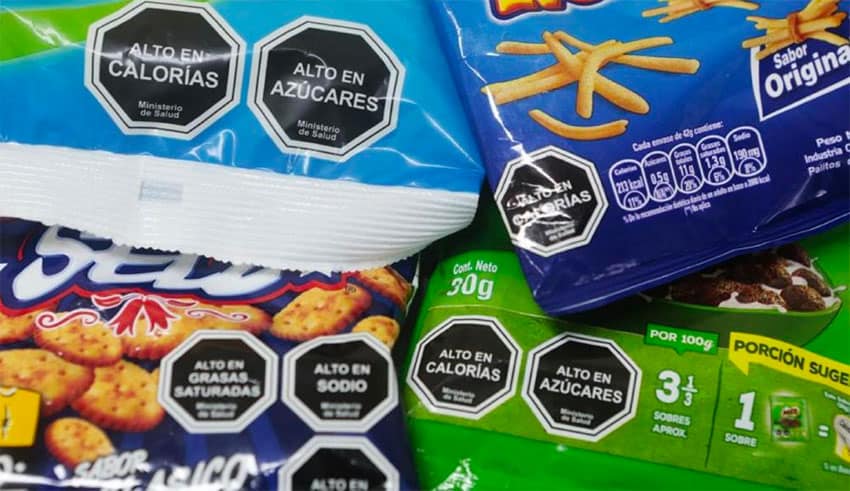
An octagonal-shaped symbol will appear on the front of products that exceed Health Secretariat guidelines.

Within the symbol, which will have a black background, white text in capital letters will warn consumers that the product is alto en (high in) one or more harmful ingredients.

Labels must also state whether a product contains ingredients that are genetically modified and include its nutritional value, including energy content and total sugar amounts, in a “direct, simple, visible and easy-to-understand way,” according to the reform approved by lawmakers.

In addition, the labels of products high in sugar must warn consumers that excessive consumption increases the risk of serious illnesses such as diabetes, obesity, cancer, cardiovascular diseases and poor oral health.

The Secretariat of Health has the right to include graphic images on products considered especially harmful to human health such as those seen on cigarette packages.

The lower house of Congress also voted in favor of outlawing the use of images of children on products that are considered harmful. Images that “cause confusion or false expectations among consumers,” such as a picture of a person exercising while consuming a product that is high in saturated fat, are also banned.

The modifications to the health law will now go to the Senate for its consideration.

Deputies’ approval of the General Health Law modifications came a day after President López Obrador acknowledged that taxes on unhealthy food and cigarettes have not been successful in discouraging their consumption.

“It can’t only be about paying more taxes,” he told reporters on Monday. “There needs to be more information for the people.”

Source: El Financiero (sp) 

Have something to say? Paid Subscribers get all access to make & read comments.
Manzanillo, Colima, México, 13 de marzo de 2026. La doctora Claudia Sheinbaum Pardo, presidenta Constitucional de los Estados Unidos Mexicanos en conferencia de prensa matutina, “Conferencia del Pueblo” desde Colima. La acompañan Indira Vizcaíno Silva, gobernadora Constitucional del Estado de Colima; Omar García Harfuch, secretario de Seguridad y Protección Ciudadana (SSPC); Raymundo Pedro Morales Ángeles, secretario de Marina (Semar); Bulmaro Juárez Pérez, divulgador de lenguas originarias, presentador de la sección “Suave Patria”; Ricardo Trevilla Trejo, secretario de la Defensa Nacional (Sedena); Jesús Antonio Esteva Medina, secretario de Infraestructura, Comunicaciones y Transportes; Bryant Alejandro García Ramírez, fiscal general del Estado de Colima; Fabián Ricardo Gómez Calcáneo; Rocío Bárcena Molina, subsecretaria de Desarrollo Democrático, Participación Social y Asuntos Religiosos de la Secretaría de Gobernación; Efraín Morales López, director general de la Comisión Nacional del Agua (Conagua); Marcela Figueroa Franco, secretaria ejecutiva del Sistema Nacional de Seguridad Pública (SESNSP) y Guillermo Briseño Lobera, comandante de la Guardia Nacional (GN). Foto: Saúl López / Presidencia

Mexico’s week in review: Congress deals Sheinbaum her first legislative defeat

0
The week of March 9 in Mexico was marked by standoffs between allies in Congress and adversaries at the airport. Here's what you missed.
A soldier displays seized handguns

The US and Mexico, growing together and growing apart: A perspective from our CEO

1
From a historic drop in homicides to opposite bets on electric vehicles, Mexico News Daily's CEO breaks down where the U.S. and Mexico are converging — and where they're not.
Veracruz Gov.

Veracruz governor blames private vessel for 200-kilometer Gulf Coast oil spill

1
The spill, which has spread to over 200 kilometers of Mexico's Gulf Coast beaches, has been traced to a private oil tanker off the coast of Tabasco.
BETA Version - Powered by Perplexity