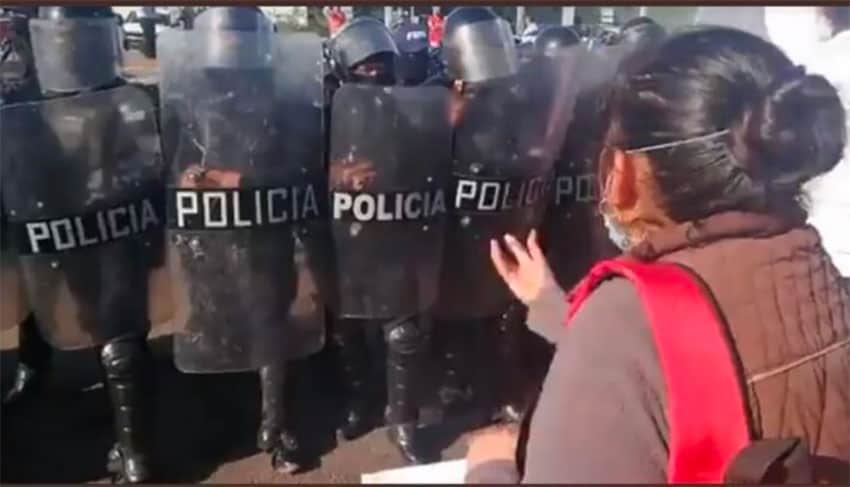
A large squadron of police in riot gear moved against a protest by families of missing persons in Guanajuato in the state’s capital city Friday.
Photos and footage of the incident show women holding up photos of their missing loved ones as police, clad in helmets and carrying shields, forced them back.
At least five women were arrested in the clash, and one suffered a leg injury after a struggle with officers.
As news of the arrests and injuries spread, the Mexico office of the United Nations High Commissioner for Human Rights called on the state government to investigate and respect the families’ right to demonstrate.
Through its social media accounts, the National Human Rights Commission also condemned police actions, urging the governor to respond to them and “address the legitimate issues they are claiming.”
Around 8 a.m. Friday, family members of missing persons who belong to the group “A Tu Encuentro,” or “Until You Are Found,” walked from the bus station, located near the toll booth on the Guanajuato-Silao highway, to the Santa Fe roundabout at the entrance to the city.
Wearing t-shirts and carrying banners with the names and faces of their missing daughters, sons, husbands and fathers, the protesters took to the street in what was initially a silent march. The demonstrators, the vast majority of whom were women, wore masks and respected social distancing as they marched.

Upon reaching the roundabout, cars were parked in the street to block vehicular traffic and marchers called on Governor Diego Sinhué Rodríguez Vallejo to take action.
“Diego, we have arrived, we are waiting for you, we have always sought dialogue. We have told you that our missing family members deserve to be treated with respect,” they proclaimed while denouncing the appointment of Héctor Díaz Ezquerra to the state’s Missing Persons Commission. “We want an explanation of why you selected a business administrator to be in charge of the commission. We will not accept it because that person is not capable,” said one of the women as the protest began.
They were met by police who asked them to move the vehicles blocking traffic and continue their protest in the roundabout’s plaza, but the women said they would not budge until the governor appeared to address their concerns.
In response, officers called in tow trucks and began pushing protesters out of the street as several struggles ensued.
In addition to the arrests, paramedics were called to attend to a woman who had allegedly been pushed to the ground by police.
Lawyer and activist Roberto Saucedo Pimentel said a claim for abuse of authority by police may be filed by the women who were “re-victimized by the state government” in the incident.
Source: Reforma (sp), Proceso (sp), Zona Franca (sp)