Mexicans’ command of English is on the decline, a new study shows.
Mexico dropped 13 places to 57th out of 88 countries on the 2018 EF English Proficiency Index (EPI).
Education First (EF) determined that English proficiency is such that an average Mexican citizen can only hold a basic conversation or write a simple email in the world’s most widely spoken second language.
In Latin America, Mexico ranks ninth out of 17 countries behind Argentina, Costa Rica, Dominican Republic, Uruguay, Chile, Brazil, Guatemala and Panama.
The EPI is based on scores from the EF Standard English Test, the world’s first free standardized English test.
In Mexico, men were found to have slightly better English proficiency than women, achieving average scores on the test of 50.28 and 49.25 respectively.
That result bucks the overall trend but is consistent with the gender-based results in Latin America.

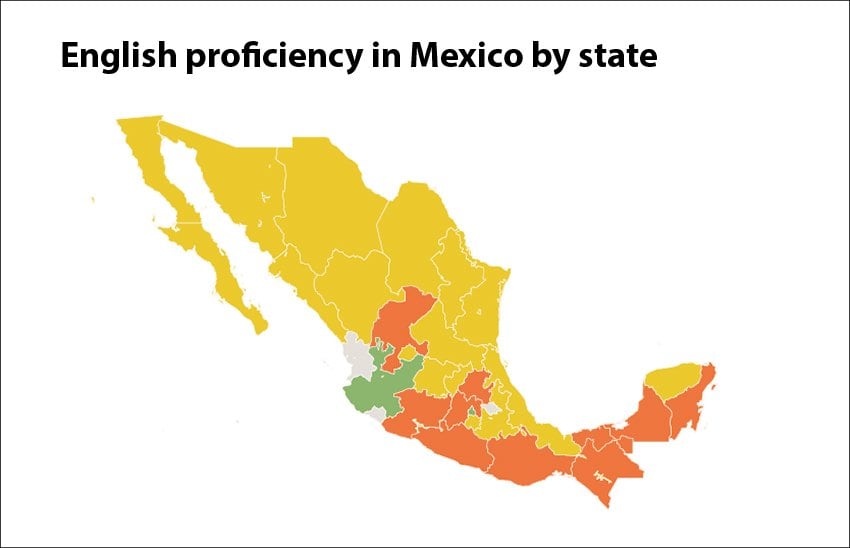
Mexico City residents fared best followed by those in Jalisco, Nuevo León, Chihuahua and Querétaro.
Residents of Guerrero, Zacatecas, Hidalgo and Campeche had the lowest English proficiency.
EF said that “in the past decades, Latin America has made enormous progress in ensuring that all children have access to education, but the region still suffers from high levels of economic inequality, fragile democracies, and unacceptable levels of violence, all of which undermine the development of a skilled workforce.”
It also said that “overcrowded schools, low teacher wages, and inadequate teacher training are all contributing factors” to low English proficiency in the region.
Latin America is the only region of the world to show a slight overall decline in English proficiency.
Europe remains the global leader, with Sweden and the Netherlands taking the top two spots. Singapore ranked third followed by Norway and Denmark.
Libya, Iraq and Uzbekistan were at the bottom.
Mexico News Daily