The Inter-American Commission on Human Rights (IACHR) has criticized the Mexican government for failing to guarantee the human rights of a wide range of people last year.
In its 2020 annual report, the IACHR said the government didn’t implement the measures needed to protect the rights of women, children and adolescents, indigenous people, migrants, prisoners, human rights defenders, journalists and members of the LGBTI community.
The commission charged that there is no strategy to prevent sexual assaults on women by members of security forces and there is a lack of mechanisms to sanction discrimination against indigenous people. It criticized the government for not carrying out adequate consultation processes with indigenous communities to gauge their opinion about large-scale infrastructure projects such as the new Mexico City airport, the Maya Train and the Isthmus of Tehuantepec trade corridor.
The commission also said the government hasn’t fully complied with many of the recommendations it made in order to reduce abductions, acts of torture and extrajudicial killings; improve Mexico’s security situation and make it easier for citizens to access justice.
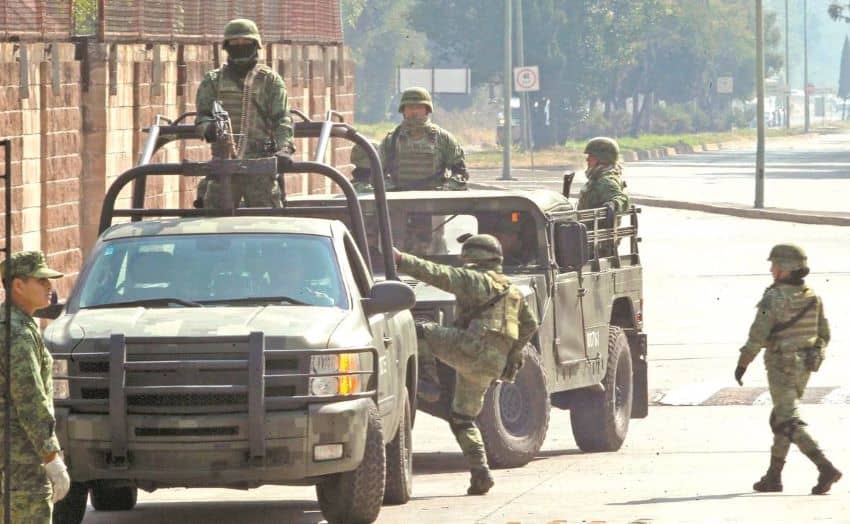
One of its recommendations was to gradually withdraw the military from the streets, where it has been carrying out public security tasks for more than a decade. Instead, President López Obrador signed a decree last May that ordered the armed forces to continue patrolling the streets until early 2024.
Another recommendation was to strengthen the nation’s police forces. But data shows that almost half of Mexico’s municipal and state police officers are not officially certified as required by the law and shouldn’t be working, while the numbers are even worse at the federal level.
The commission questioned why there is no established protocol for abductions committed by security force members to be investigated by independent experts and noted that there is no national registry with information about located hidden graves and unidentified human remains.

The IACHR acknowledged that there are structures in place in Mexico to protect human rights but violations continue to occur regardless.
“The challenge of the Mexican state is to close the gap that exists between its legal framework and its recognition of human rights with the reality that a large number of inhabitants experience,” it said.
Mexico needs to “redouble its efforts” to prevent human rights violations, the commission added.
Of particular concern, the IACHR said, was the high number of abductions and homicides that were not properly investigated. “Structural impunity” in Mexico encourages the repetition of crimes that violate people’s human rights, it said.
The publication of the IACHR report comes just after Amnesty International (AI) released its own damning report on human rights violations in Mexico.
Unlawful killings, arbitrary detentions, enforced disappearances and violence against women and girls were among a range of violations cited by AI.
Source: El Universal (sp)