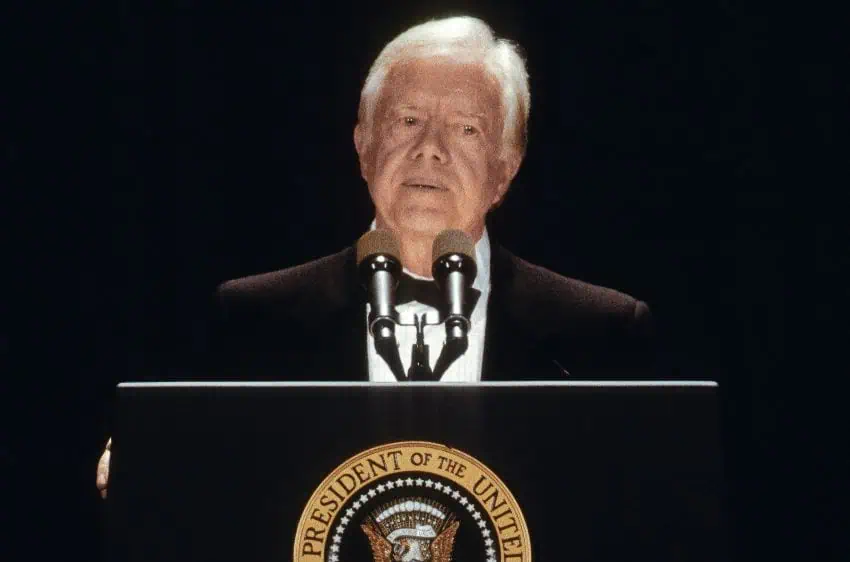
Mexico’s Foreign Affairs Ministry (SRE) lamented the death of former U.S. president Jimmy Carter, who died at his home in Georgia on Sunday aged 100.
In a message posted to X, the SRE offered “its most sincere condolences … to the family of the former president, as well as to the people and government of the United States for this regrettable loss.”
El @GobiernoMX, a través de la @SRE_mx, expresa sus más sinceras condolencias por el fallecimiento del ex presidente de Estados Unidos, James E. Carter Jr., ocurrido hoy en su natal Georgia.
México extiende sus condolencias a la familia del ex mandatario, así como al pueblo y al…
— Relaciones Exteriores (@SRE_mx) December 30, 2024
As president from 1977-1981, Carter broke with prevailing U.S. foreign policy early in his term, outlining a vision based on protecting human rights.

Carter proclaimed a new era in U.S.-Mexico relations, while also pledging to end the tradition of U.S. interventionism in Latin America. Additionally, he offered to support the development of democracy through multilateral cooperation.
That same year he signed the Torrijos-Carter Treaties, guaranteeing that Panama would gain control of the Panama Canal after 1999.
In 1978, Carter again put his new foreign policy into action, straddling the geopolitics of the Cold War while seeking solutions to address a revolution in Nicaragua, where the Somoza dictatorship had been seen as a U.S. ally. Carter criticized the military dictatorship’s abuses, pushed for a path to democratic transition and eventually ended military assistance to the Somoza government in January 1979.
Jimmy Carter lived a life devoted to justice & human rights. As President, he created the White House Office of Hispanic Affairs & appointed a record number of Latinos to the Administration. May he rest in peace.
Photo: President Carter visits Mexico City, 1979. pic.twitter.com/ANGjkgOsNw
— Mexican American Civil Rights Institute (MACRI) (@SomosMACRI) December 29, 2024
Carter’s visit to Mexico in 1979
In February 1979, Carter made what the New York Times described as a “troubled visit to Mexico,” during which he and then-Mexican president Jose López Portillo agreed to start negotiations for the U.S. purchase of Mexican natural gas.
While in Mexico City, Carter spoke in Spanish to a joint session of Congress, famously quoting storied Mexican poet Octavio Paz: “What separates us is the very thing that unites us. We are two distinct versions of Western civilization.”
But he also spoke hopefully: “Our perceptions of each other have sometimes been distorted,” he said. “But we have made progress, and I believe that in the coming years we will make greater progress toward fuller cooperation, understanding and mutual respect.”
During the three-day visit to Mexico, the two presidents agreed to close consultations on the issue of undocumented Mexicans in the United States, but made little progress on other issues that divided the two nations, including trade and border control.
With reports from El Economista, Infobae, Milenio and The New York Times