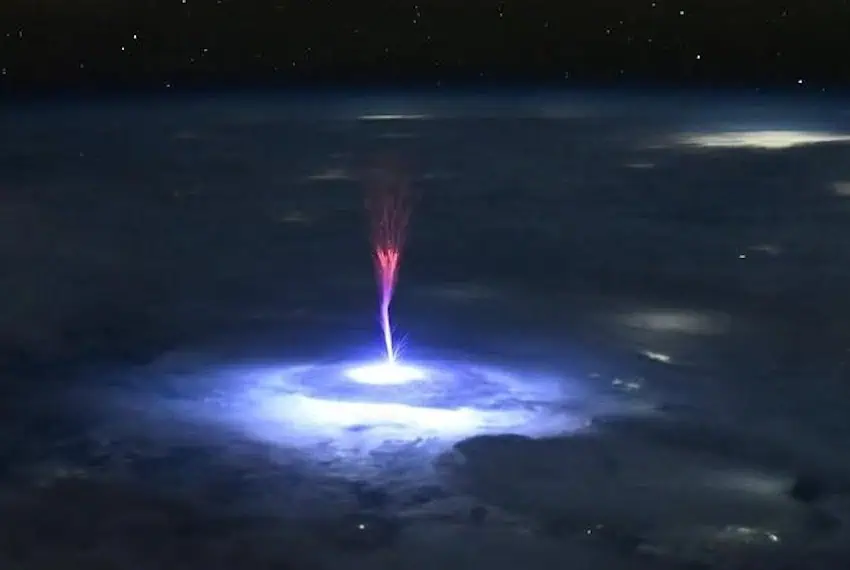
NASA recently captured a light phenomenon known as an “atmospheric sprite” over Mexican territory, near the border with the United States. This event, which looks like an inverted red lightning strike, was photographed from the International Space Station (ISS).
Sprites — more formally, transient luminous events or TLEs — are rare electrical discharges that occur between 50 and 90 km above the Earth’s surface, in the mesosphere.
Just. Wow. As we went over Mexico and the U.S. this morning, I caught this sprite.
Sprites are TLEs or Transient Luminous Events, that happen above the clouds and are triggered by intense electrical activity in the thunderstorms below. We have a great view above the clouds, so… pic.twitter.com/dCqIrn3vrA
— Nichole “Vapor” Ayers (@Astro_Ayers) July 3, 2025
Unlike traditional lightning, which shoots downward, sprites shoot upward from the tops of storm clouds, forming branching, reddish or bluish structures that can extend up to 96 km above the storm. They typically last only fractions of a second, making them difficult to observe from the ground.

The geographic location and frequency of convective thunderstorms make Mexico’s skies an ideal environment for the sprite phenomenon.
“Just. Wow. As we went over Mexico and the U.S. this morning, I caught this sprite,” Nichole Ayers, the astronaut who took the photograph, wrote in her official Instagram account, accompanied by the image taken from space.
The ISS offers a privileged view for capturing these phenomena, as they can be observed from space above the clouds.
According to Ayers, sprite images help scientists better understand the formation of these electrical events, their relationship to storms, and their impact on the upper atmosphere. They also contribute to improving weather and atmospheric electrical activity models.
Ayers’s image aligns with NASA’s “Spritacular” project, an initiative that seeks to collect images of these events.
Sprites were first photographed in 1989, and although pilots had previously reported them, they remain enigmatic and little-studied due to their transience and altitude. The recent image captured by NASA represents an important contribution to atmospheric science and the understanding of these electrical phenomena.
With reports from El Imparcial and W Radio