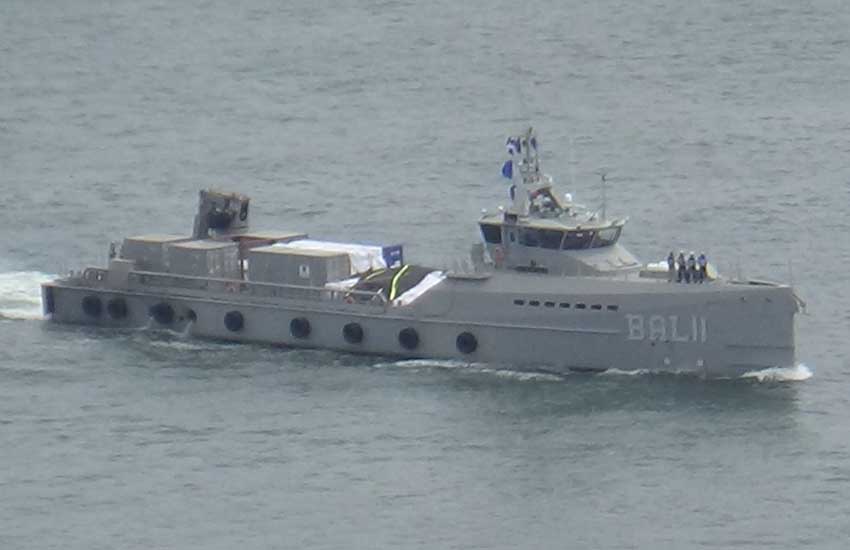
The Mexican navy said today it has built 14 new military vessels during the last six years and collaborated with state oil company Pemex to update its fleet of tugboats and supply ships.
The Secretariat of the Navy (Semar) said in a statement that strengthening the navy’s capacity during the current federal administration has included the construction of eight new coastal patrol boats, two offshore patrol vessels, two interceptor patrol vessels and two logistics support vessels.
All of the coastal patrol boats were built at the Semar Shipyard No. 1 in Tampico, Tamaulipas, and are named after Mexican archaeological sites.
ARM Palenque and Mitla were built in 2014; Uxmal and Tajín in 2015; Tulum and Monte Albán in 2016; Bonampak in 2017; and Chichén Itza this year.
Two offshore patrol vessels — ARM Chiapas and Hidalgo — were also completed in Tampico this year while two more are under construction, one at the same shipyard and another at the Semar Shipyard No. 20 in Salina Cruz, Oaxaca.
The navy said that “with the construction of the offshore patrol vessels, the Secretariat of the Mexican Navy will increase the efficiency of its surveillance tasks in territorial waters and the exclusive economic zone.”
Both interceptors — ARM Circini and Gienah — were built at the Navy Shipyard No. 3 in Coatzacoalcos, Veracruz, and completed in 2015.

Semar said the main characteristics of the vessels, which are used for surveillance, security and rescue work, are their “high speed, high maneuverability and versatility.”
The two logistics vessels — ARM Libertador and Isla María Madre — were built at the No. 6 Semar Shipyard in Guaymas, Sonora, and delivered in 2012.
One is equipped to provide support to the civilian population in case of emergency situations or natural disasters and also protects Mexico’s maritime interests, while the other is mainly involved in supporting economic activities in the Islas Marías archipelago, located off the coast of Nayarit.
Semar also said it has built and repaired other public and private sector vessels at its shipyards on the country’s Pacific and Gulf of Mexico coasts.
One of the beneficiaries is the state oil company Pemex, which has worked with Semar to build new tugboats, supply ships and freighters for its fleet.
All of the 16 new 50 to 60-tonne tugboats — eight of which have already been completed — bear the names of indigenous groups including Tarahumara, Huichol, Mixteco, Triqui and Maya.
Two 450-tonne supply ships are still under construction in Guaymas and are scheduled to be completed and delivered before the end of the year, Semar said.
Another supply vessel currently being built in Tampico is more than 99% complete.
The navy said its design, construction and repair of a range of vessels served to “strengthen the naval industry [and] generate quality jobs, with permanent training and the use of cutting-edge technology.”
Mexico News Daily