Nearly 5,000 cases of electricity theft in Oaxaca market a ‘time bomb’

The Federal Electricity Commission (CFE) has detected 4,800 separate cases of power theft at the largest public market in Oaxaca.

The illegal connections at the Central de Abasto market in Oaxaca city cost the public utility around 5 million pesos (US $265,000) a month, the CFE said.

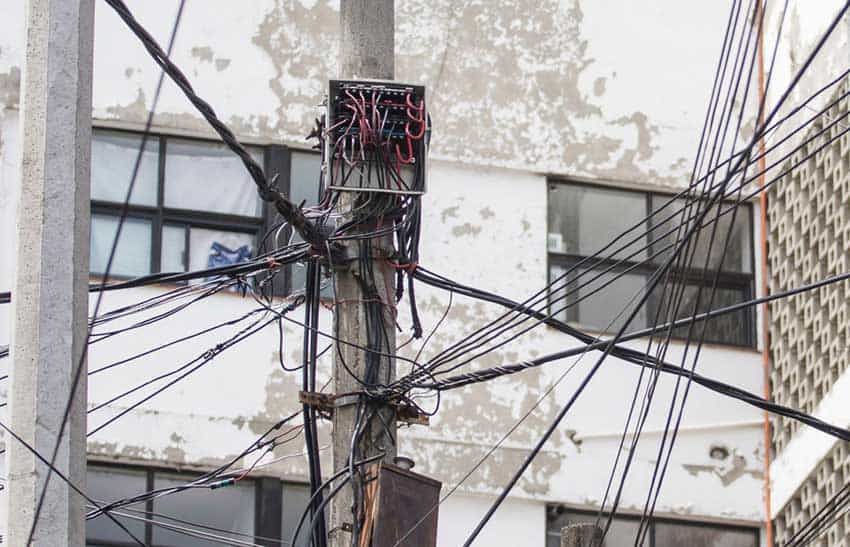
It also warned of the possibility of explosions as a result of “serious overload risks” at the hidden connection points, representing a potential danger to the public.

Heliodoro Díaz Escárraga, chief of the Oaxaca Civil Protection services, also said there was a high risk of a fatal explosion or fire at the market, which is the workplace for 16,000 vendors and patronized by 20,000 shoppers on a daily basis.

He said authorities are currently planning an operation to disconnect all the illegal hook-ups, which are known colloquially in Mexico as diablitos (little devils). Rewiring the whole market will cost 70 million pesos (US $3.7 million), Díaz estimated.

“. . . The [power] supply has to be returned to normal and everyone has to be obliged to pay for the use of energy . . . We have to avoid a tragedy because the way that all the cables and diablitos are [at the moment], it’s a time bomb,” he said.

The official explained that 200 illegal connections in the historic center of Oaxaca that were used both by bricks-and-mortar establishments and street vendors’ stalls have already been disconnected.

Those diablitos were costing the CFE around 1.5 million pesos (US $79,500) a month.

Esther Merino, a member of a Oaxaca city business association, said that street vendors are the main electricity thieves and that the crime has increased since the new municipal government took office at the start of this year.

The CFE announced last month that electricity theft cost the company 30 billion pesos (US $1.6 billion) last year.

Director Manuel Bartlett Díaz explained that large and small business, hotels and industry were all guilty of stealing power, declaring that “this is a situation we must now fight against.”

Source: El Financiero (sp), Milenio (sp) 

Have something to say? Paid Subscribers get all access to make & read comments.
Manzanillo, Colima, México, 13 de marzo de 2026. La doctora Claudia Sheinbaum Pardo, presidenta Constitucional de los Estados Unidos Mexicanos en conferencia de prensa matutina, “Conferencia del Pueblo” desde Colima. La acompañan Indira Vizcaíno Silva, gobernadora Constitucional del Estado de Colima; Omar García Harfuch, secretario de Seguridad y Protección Ciudadana (SSPC); Raymundo Pedro Morales Ángeles, secretario de Marina (Semar); Bulmaro Juárez Pérez, divulgador de lenguas originarias, presentador de la sección “Suave Patria”; Ricardo Trevilla Trejo, secretario de la Defensa Nacional (Sedena); Jesús Antonio Esteva Medina, secretario de Infraestructura, Comunicaciones y Transportes; Bryant Alejandro García Ramírez, fiscal general del Estado de Colima; Fabián Ricardo Gómez Calcáneo; Rocío Bárcena Molina, subsecretaria de Desarrollo Democrático, Participación Social y Asuntos Religiosos de la Secretaría de Gobernación; Efraín Morales López, director general de la Comisión Nacional del Agua (Conagua); Marcela Figueroa Franco, secretaria ejecutiva del Sistema Nacional de Seguridad Pública (SESNSP) y Guillermo Briseño Lobera, comandante de la Guardia Nacional (GN). Foto: Saúl López / Presidencia

Mexico’s week in review: Congress deals Sheinbaum her first legislative defeat

0
The week of March 9 in Mexico was marked by standoffs between allies in Congress and adversaries at the airport. Here's what you missed.
A soldier displays seized handguns

The US and Mexico, growing together and growing apart: A perspective from our CEO

1
From a historic drop in homicides to opposite bets on electric vehicles, Mexico News Daily's CEO breaks down where the U.S. and Mexico are converging — and where they're not.
Veracruz Gov.

Veracruz governor blames private vessel for 200-kilometer Gulf Coast oil spill

1
The spill, which has spread to over 200 kilometers of Mexico's Gulf Coast beaches, has been traced to a private oil tanker off the coast of Tabasco.
BETA Version - Powered by Perplexity