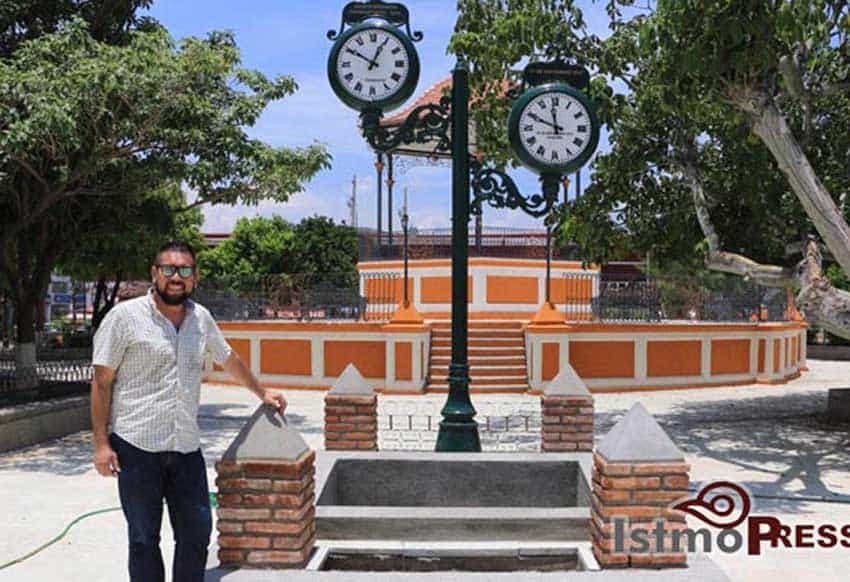
Tehuantepec’s two new clocks: one marks earthquake time

A memorial clock marking the exact time that last year’s powerful earthquake struck has been erected in a Oaxaca municipality that felt the full force of the shock.

Alongside the clock that is permanently set to 11:49pm is another showing the current time. Both are part of the same monument, which now stands in the town square of Santo Domingo Tehuantepec.

A time capsule containing information about the devastating natural disaster that occurred on September 7, as well as artifacts of Zapotec culture, will be buried beneath the clocks.

Luis Díaz Jiménez, a heritage official at the municipal council, told the newspaper Milenio that the idea behind the memorial was to pay tribute to the 82 people from the Isthmus of Tehuantepec region who lost their lives in last September’s temblor.

The clock marking 11 minutes to midnight will also serve as a reminder of the need to be ready at all times for any kind of natural disaster that could strike, he added.

[wpgmza id=”72″]

Díaz explained that the time capsule will be covered with a concrete slab after burial and that instructions will be left for it to be opened in 100 years. Documents, photographs, traditional textiles, clothing, arts, crafts and jewelry are all slated to be included.

To mark the one-year anniversary of the earthquake this Friday, Díaz said, a silent procession will pass through the town’s streets and that a globo de cantoya, or sky lantern, will be released in memory of the quake victims.

Fortunately, most of the people in Santo Domingo who lost their homes in the earthquake have now managed to rebuild thanks to financial aid from the federal government.

However, it is estimated that more than half the people whose homes collapsed or were damaged in other parts of the Isthmus region have not yet rebuilt or repaired their dwellings.

Four out of every 10 quake-damaged schools in Oaxaca are also still waiting for repairs.

In Juchitán, the region’s commercial hub, 200 residents say that they were defrauded of the government aid they received by unscrupulous builders who took their money and ran.

Source: Milenio (sp)

Have something to say? Paid Subscribers get all access to make & read comments.
Manzanillo, Colima, México, 13 de marzo de 2026. La doctora Claudia Sheinbaum Pardo, presidenta Constitucional de los Estados Unidos Mexicanos en conferencia de prensa matutina, “Conferencia del Pueblo” desde Colima. La acompañan Indira Vizcaíno Silva, gobernadora Constitucional del Estado de Colima; Omar García Harfuch, secretario de Seguridad y Protección Ciudadana (SSPC); Raymundo Pedro Morales Ángeles, secretario de Marina (Semar); Bulmaro Juárez Pérez, divulgador de lenguas originarias, presentador de la sección “Suave Patria”; Ricardo Trevilla Trejo, secretario de la Defensa Nacional (Sedena); Jesús Antonio Esteva Medina, secretario de Infraestructura, Comunicaciones y Transportes; Bryant Alejandro García Ramírez, fiscal general del Estado de Colima; Fabián Ricardo Gómez Calcáneo; Rocío Bárcena Molina, subsecretaria de Desarrollo Democrático, Participación Social y Asuntos Religiosos de la Secretaría de Gobernación; Efraín Morales López, director general de la Comisión Nacional del Agua (Conagua); Marcela Figueroa Franco, secretaria ejecutiva del Sistema Nacional de Seguridad Pública (SESNSP) y Guillermo Briseño Lobera, comandante de la Guardia Nacional (GN). Foto: Saúl López / Presidencia

Mexico’s week in review: Congress deals Sheinbaum her first legislative defeat

0
The week of March 9 in Mexico was marked by standoffs between allies in Congress and adversaries at the airport. Here's what you missed.
A soldier displays seized handguns

The US and Mexico, growing together and growing apart: A perspective from our CEO

0
From a historic drop in homicides to opposite bets on electric vehicles, Mexico News Daily's CEO breaks down where the U.S. and Mexico are converging — and where they're not.
Veracruz Gov.

Veracruz governor blames private vessel for 200-kilometer Gulf Coast oil spill

1
The spill, which has spread to over 200 kilometers of Mexico's Gulf Coast beaches, has been traced to a private oil tanker off the coast of Tabasco.
BETA Version - Powered by Perplexity