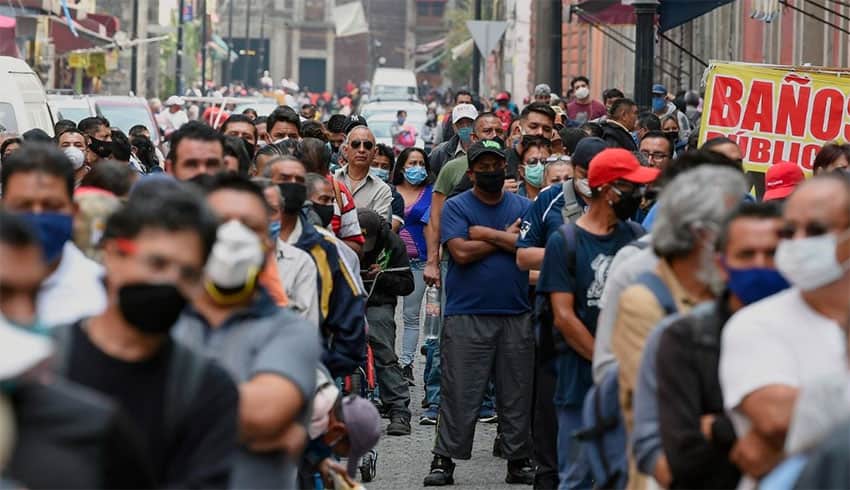
New measures announced by the Mexico City government to reduce foot traffic in the historic center amid the coronavirus pandemic failed to prevent large crowds of shoppers on Monday.
The newspaper La Jornada reported that the capital’s downtown area was bustling with people and that long lines of shoppers formed outside several shops.
Mexico City authorities announced a new scheme on Sunday under which residents should only go to the historic center on certain days depending on the first letter of their first surname. They also recommended that only one person per family travel into the downtown area in order to reduce the size of crowds.
However, La Jornada said that no efforts were made to verify shoppers’ surnames, and that entire families strolled the streets of the capital’s center.
There were scant efforts to limit the number of shoppers on busy streets, with city officials only forcing people to wait to access one particularly bustling one located adjacent to the National Palace. That strategy, however, only caused a crowd of shoppers to gather in close proximity.
La Jornada also reported that many odd-numbered businesses that should have been closed on Monday according to government restrictions secretly allowed people in to shop behind closed doors.
Informal street vendors known as ambulantes also added to the crowds on the historic center streets, where they hawked a range of products including USB flash drives, medicinal plants, food, antibacterial gel and face masks.

With many historic center streets turned into pedestrian-only thoroughfares, traffic was dense on those that remained open to vehicles.
Mexico City transitioned to “orange light” coronavirus restrictions last week, a move that allowed many businesses to reopen at a reduced capacity. However, after large crowds of shoppers descended on the historic center, the government ordered nonessential businesses to close over the weekend as it rethought its reopening strategy.
Given yesterday’s crowds, they may be forced to go back to the drawing board once again, or at least enforce the existing restrictions.
Covid-19 case numbers and hospital admissions have trended downwards in the capital in recent weeks but Mayor Claudia Sheinbaum has expressed concern that new infections could spike as more and more people resume their everyday activities.
Announcing the switch to “orange light” restrictions in late June, Sheinbaum stressed that if hospital occupancy levels exceed 65%, stricter “red light” restrictions will be reinstated.
Source: La Jornada (sp)