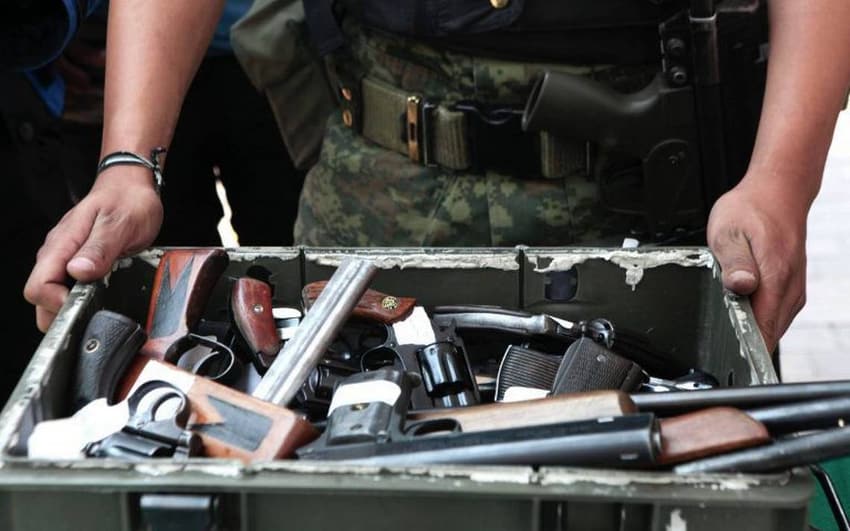
The number of firearms citizens turned into authorities under buyback and amnesty schemes declined significantly in the first three years of the current government compared to the same period of its predecessor, official data shows.
Via a freedom of information request, the newspaper El Universal obtained federal government data that showed that 9,975 guns were surrendered to the army and destroyed between 2019 and 2021, an 86% decline compared to the three-year period between 2013 and 2015, when 71,785 firearms were turned in by citizens.
The decline had begun by the second half of former president Enrique Peña Nieto’s six-year term and continued after President López Obrador took office. The number of firearms surrendered in the past three years is 55% lower than the 22,355 turned in between 2016 and 2018. Just 1,167 were handed in last year, compared to more than 31,000 in 2013.
Under different programs, citizens have been able to exchange firearms for cash, vouchers, domestic appliances and furniture. Prices paid range from less than 200 pesos (about US $10) to more than 16,000 pesos (almost US $800) depending on the kind of weapon.
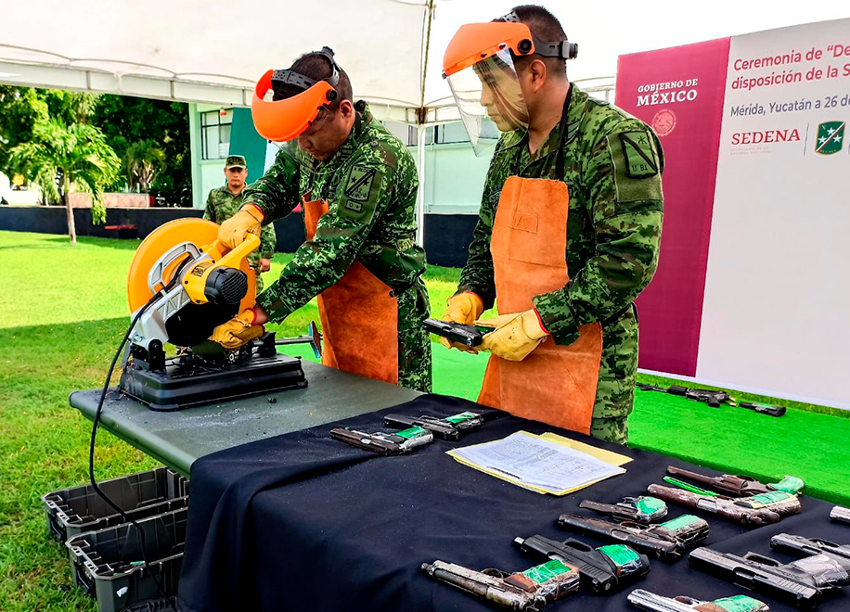
While the number of guns surrendered between 2019 and 2021 declined 86% compared to the first three years of Peña Nieto’s term, the number of homicides committed with firearms increased 120% from 27,632 between 2013 and 2015 to 60,718 in the 36 months to the end of December 2021.
The inference is that people haven’t turned in weapons in great numbers in the last three years because they are worried about the high levels of gun violence and want to be able to protect themselves if need be.
José Andrés Sumano Rodríguez, an academic at the College of the Northern border who researches violence, told El Universal that people in some parts of the country decide to get a gun to protect their family and assets because the government’s security strategy isn’t working.

Gun ownership is legal in Mexico, but firearms can only be legally bought at one army-run store in Mexico City. They are, however, widely available on the black market. A 2021 study concluded there were firearms in at least 1.89 million Mexican homes, a figure that represents 5.5% of all households in the country.
The purpose of gun buyback programs is ultimately to reduce violence, but Sumano says they firearms surrendered in Mexico are “not the rifles or pistols” generally used in homicides.
Citizens generally hand in guns that are very old or don’t work, he said. “[The purpose of] these kinds of programs is to disarm people, but they haven’t yielded the expected results,” Sumano said. “We’re not going to find a Barrett rifle or an AK-47” among the weapons turned in, he added.
The newspaper Milenio, which also obtained data on surrendered firearms, reported that very few guns have been handed in recent years in highly violent states such as Baja California, Guerrero and Guanajuato. The numbers have been much higher in Mexico City, although there was a reduction there in 2020 and again in 2021.
The Ministry of Foreign Affairs said in 2019 that more than more than 200,000 guns are smuggled into Mexico every year. It also said that firearms from the United States are used in seven out of every 10 high-impact crimes.
With reports from El Universal and Milenio