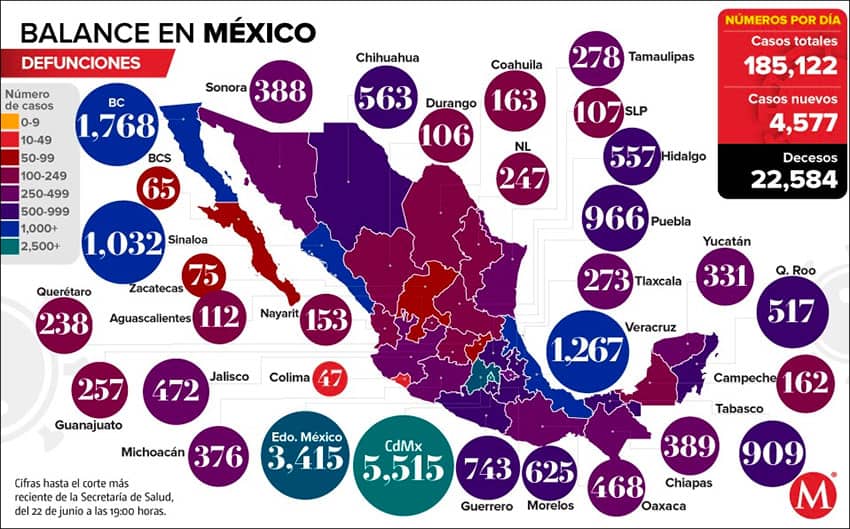
More than 4,000 new cases were added to Mexico’s coronavirus case tally on Monday and the death toll increased by over 700 but there are signs that the national epidemic curve may have begun to flatten, according to a federal health official.
Director of Epidemiology José Luis Alomía reported 4,577 new Covid-19 cases, increasing the total number of accumulated cases to 185,122.
He said that the Health Ministry registered 759 additional Covid-19 deaths on Monday, lifting the death toll to 22,584. An additional 1,874 fatalities are suspected to have been caused by Covid-19 but have not yet been confirmed.
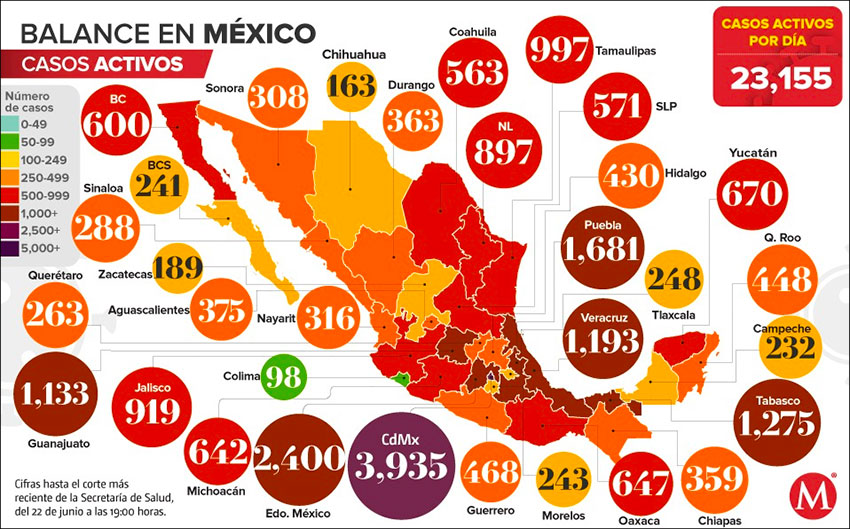
Alomía said that 23,155 confirmed cases are considered active – a decrease of 1,070 compared to Sunday – and that there are 57,281 suspected cases across the country. More than 488,500 people have now been tested for Covid-19 since the disease was first detected in Mexico at the end of February.
Alomía presented a graph showing both confirmed and suspected Covid-19 cases, explaining that the latter are cases for which the results of Covid-19 tests are not yet known.
He said that if both the confirmed and suspected cases are taken into account, the epidemic curve is showing a clear upward trend. However, he stressed that not all of the suspected cases will actually turn out to be actual cases of Covid-19.
In that context, Alomía explained that health authorities use testing positivity rates – around 40% of Covid-19 tests have so far come back positive – to estimate what percentage of the suspected cases will become confirmed coronavirus cases.

That allows the creation of “an estimated epidemic curve,” he said, explaining that at the start of June said curve – “which was rising” – started to show “a little bit of stability.”
“In coming days, we’ll see if this stability is maintained,” Alomía said, adding that it was possible that the national epidemic curve will start to trend downwards.
However, health officials have emphasized repeatedly that the coronavirus pandemic is not affecting Mexico uniformly. Therefore, a downward trending national epidemic curve will not signify that all regions of the country have passed the peak of the first wave of the coronavirus outbreak.
Some states currently have relatively small active outbreaks of Covid-19, with cases numbering fewer than 250, while others have thousands of patients who tested positive after developing symptoms in the past 14 days.
In the former category are states such as Colima, Chihuahua and Zacatecas, while in the latter are Mexico City and México state, among others.
Mexico City currently has 3,935 active cases, while México state has 2,400, according to Health Ministry data. Four other states – Puebla, Tabasco, Veracruz and Guanajuato – have more than 1,000 active cases.
The capital also has the highest Covid-19 death toll in the country, with 5,515 confirmed fatalities as of Monday.
Four states have recorded more than 1,000 deaths: México state, with 3,415; Baja California, with 1,768; Veracruz, with 1,267; and Sinaloa, with 1,032.
Based on confirmed cases and deaths, Mexico’s fatality rate is currently 12.2 per 100 cases, well above the global rate of 5.2.
The average age of coronavirus patients who have died is 61 and men account for 66% of fatalities. Seven in 10 of those who died had at least one existing health condition that made them more vulnerable to Covid-19.
The most common health problems among those who have died are hypertension, diabetes and obesity. About one in 10 deceased patients were smokers, Health Ministry data shows.
Among the more than 22,500 people who have succumbed to Covid-19 in Mexico were 50 pregnant women and 43 foreigners.
National data presented at Monday night’s coronavirus press briefing showed that only 44% of general care beds set aside for coronavirus patients are currently occupied while 38% of those with ventilators are in use.
Hospitals in Mexico City, México state and Tlaxcala have the highest occupancy levels for general care beds, with rates of 69%, 69% and 60%, respectively.
México state, Baja California and Sonora have the lowest availability of beds with ventilators, with 65%, 63% and 57%, respectively, of their total number currently in use.