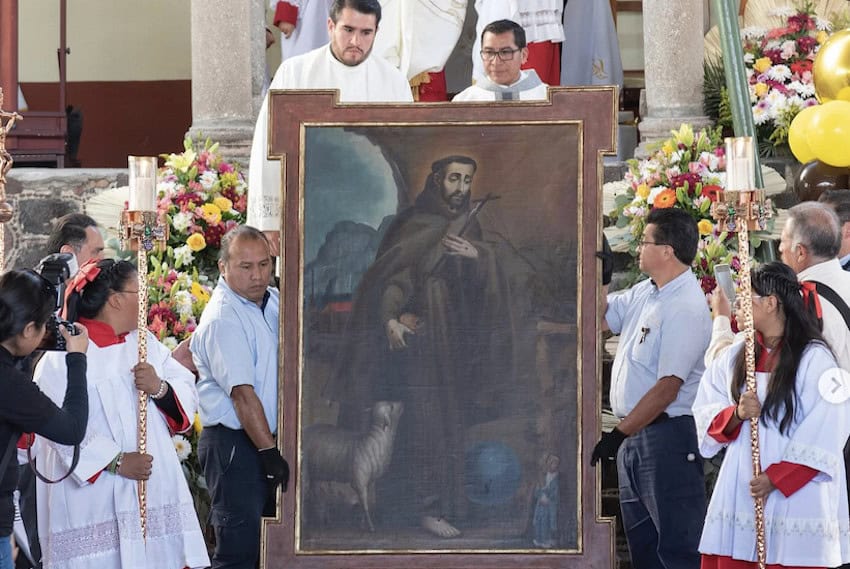
A treasured 18th-century painting of Saint Francis of Assisi — taken in a nighttime heist from a church in México state nearly 25 years ago — has returned after years of investigation and faith-fueled waiting.
Dated Dec. 3, 1747, the oil painting was stolen from the Church of San Francisco Mazapa on Jan. 6, 2001. Eighteen works disappeared that night, but only this one has resurfaced.
The parish is in a town of 3,300 adjacent to the Teotihuacán archaeological zone, a massive UNESCO World Heritage Site that includes the Pyramid of the Sun. It’s about an hour’s drive northwest of Mexico City.
The painting stands out for many reasons, including its large, church-display size of 159 centimeters high by 101 centimeters wide (5.2 feet by 3.3 feet) — making it comparable to some of the world’s most famous single-panel gallery paintings.
Its recovery began roughly eight years ago, when the alleged owner took it to the Morton Auctions house in Mexico City and left it on consignment, said historian David Collepardo.
The piece was flagged as stolen, and reported to Interpol, after a database check with the Art Loss Register, which tracks missing art and antiques worldwide.

“We stopped the auction process,” said Collepardo, Morton’s manager of antiques and books. “The Art Loss Register filed the corresponding reports with the prosecutor’s office.”
And why did a resolution take so long? Collepardo said it was due to legal red tape.
Published reports indicate that the person who brought the stolen painting to the auction house was never reprimanded or criminally charged. Authorities attempted to contact that person, but no response was received.
The outcome is typical of sacred art thefts in Mexico, where stolen items are sold or transferred through intermediaries, but legal actions focus on recovering the artwork rather than on prosecution.
The Mexican government has an international campaign to recover Mexican artifacts that uses the slogan #MiPatrimonioNoSeVende (“My Heritage is Not for Sale”).
The returned painting shows Saint Francis of Assisi holding a skull and a crucifix, stigmata on his hands and feet, and bears a dedication to Don Gregorio Juan, an Indigenous mayor of Mazapa.
Community members said its arrival restores a lost part of their identity.
“The recovery of our painting is of inexplicable significance to the faith of local people,” said parish priest Teodoro García Romero.
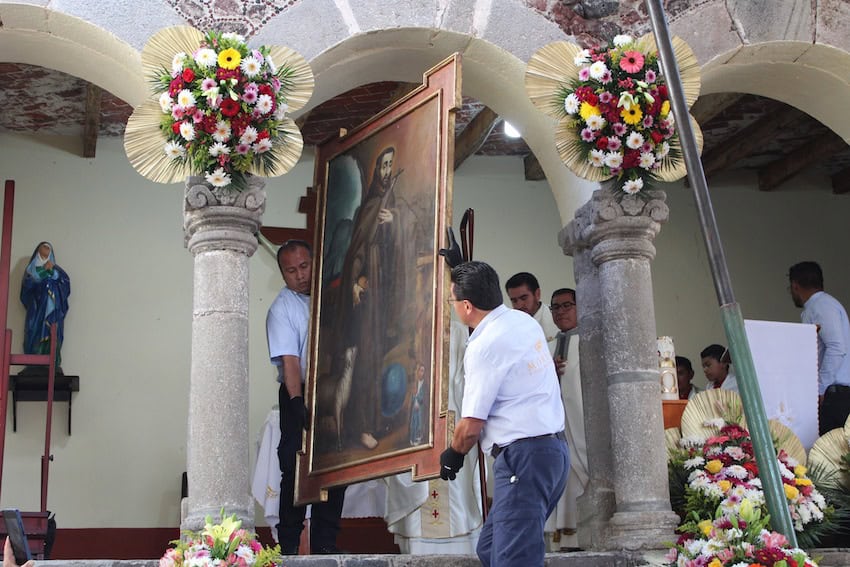
The Art Loss Register confirmed on Instagram that it worked pro bono with Morton Auctions to secure the return.
Photos posted show more than 1,000 residents celebrating on Sunday as the artwork was rehung in the parish.
“It’s a reminder that stolen cultural heritage, feared lost forever, can be returned to its rightful home,” the registry wrote.