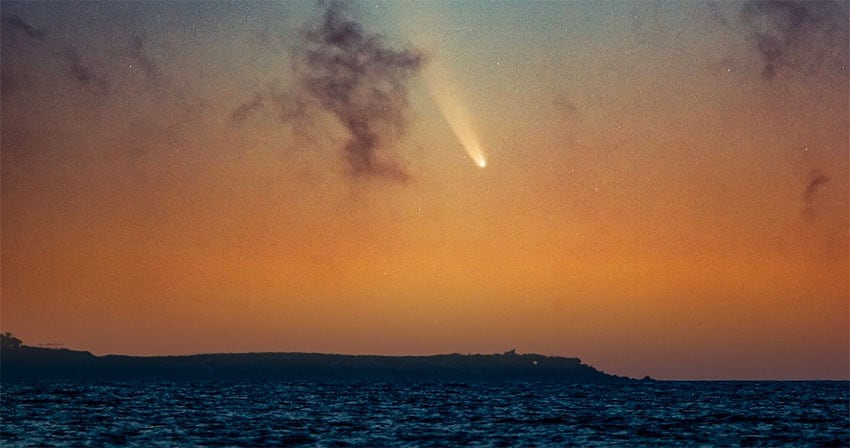
A Mexican photographer took a photograph of the comet Neowise that has been shared on social media by the United States National Aeronautics and Space Administration (NASA).
Roberto Fernández rose before dawn for five days in a row trying to capture the comet’s image, which he finally did on Tuesday, photographing the celestial body over Isla Mujeres in Quintana Roo.
“Happy, happy, happy today,” Fernández wrote on his Twitter account after learning that NASA had shared his photo. “The image was captured in Cancún and you can see the southern tip of Isla Mujeres. If you look carefully, you can see the temple of the goddess Ixchel.”
The comet is visible to the naked eye in dark skies with little or no light pollution, but binoculars are needed to see the tail, NASA said.
Comet Neowise passed through Mercury’s orbit just over a week ago. Its proximity to the sun caused dust and gas to burn on its surface and created a long tail of debris.
NASA’s Neowise Infrared Space Telescope discovered the comet in March, but it will be visible throughout the Northern Hemisphere until mid-August when it will again head toward the outer zone of the solar system.
It will be about 7,000 years before the comet returns, “so I wouldn’t suggest waiting until the next time it happens,” said Joe Masiero, deputy principal investigator at NASA’s jet propulsion laboratory in Pasadena, California.

The comet will be closest to Earth on July 23 when it will be 103 million kilometers away. It is visible in the northeastern part of the sky in predawn hours, and in the northwest just under Ursa Major about 45 minutes after sunset.
“What you want to do is go out right around the time that the first stars start to show up. You’re not going to be able to see it before that,” Masiero said. “It’s probably about as bright as some of the stars in the Big Dipper.”
Neowise was discovered on March 27, 2020, and was named for the telescope through which it was first viewed. It is the brightest comet visible from earth since Hale-Bopp in 1997.
The comet has been photographed in the United States, France, Croatia, Switzerland, Canada and twice in Mexico, in Zacatecas and Cancún.
Source: Infobae (sp), Sin Embargo (sp), Space (en)