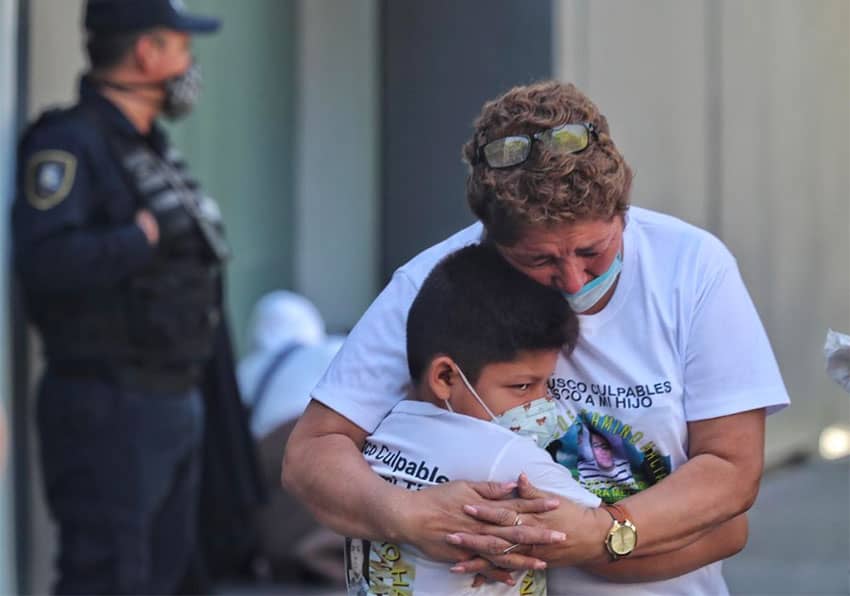
Hundreds of demonstrators gathered in at least 14 states Sunday — the International Day for Victims of Forced Disappearances — to demand justice for the thousands of missing-persons cases across the nation and to put an end to high rates of kidnapping.
From Baja California to Veracruz, from Tamaulipas to Sinaloa, parents and children of kidnapping victims and other advocates gathered in front of government buildings, in cathedrals, in the zócalo in Mexico City and many other places to hold rallies and demonstrations.
They set up information kiosks to inform the public and to urge an end to what organizers say is a pattern of unwillingness by authorities to investigate such crimes.
Organizers accused authorities throughout Mexico of manipulating kidnapping figures for years in order to suppress the true number of victims and generally refusing to investigate disappearances. Activists in Puebla, for example, pointed out that while the state attorney general’s figures list 1,700 missing, the National Registry of Missing Persons estimates there are 3,500 cases.
In Tamaulipas, the state with the highest number of missing persons cases at 11,000, various NGOs demonstrating in Reynosa called on authorities not to abandon investigations, accusing the state Attorney General’s Office of merely archiving filed reports.
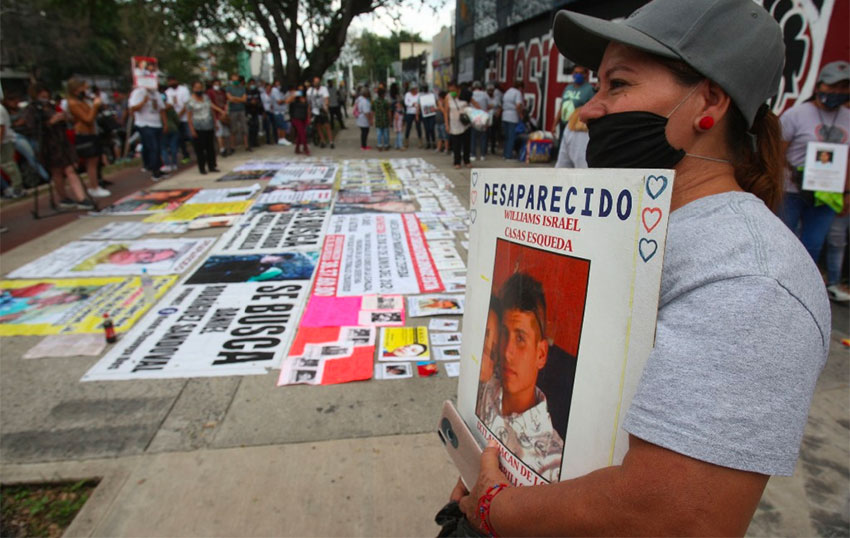
In Jalisco, which at 10,268 has the second-highest number of cases nationwide, Families United for Our Disappeared held a Mass in the Guadalajara cathedral before staging a rally.
In Baja California, activists gathered in Tijuana, the city where notorious gang member Santiago Meza says he dissolved 300 men in acid by order of Tijuana cartel drug baron Teodoro García. It is estimated that 1,225 people have gone missing in the city since 2015.

In Mexico City, mothers, sisters, and daughters of kidnapping victims gathered at the National Search Commission headquarters and at the zócalo. In Chihuahua, various activist groups took to the streets and to municipal cemeteries in Cuauhtémoc and Parral to demand the truth about their missing loved ones.
In some cities there were creative attempts to educate the public and give protests a sense of permanence. In Irapuato, Guanajuato, organizers constructed three informational kiosks where they placed 100 placards with the names of missing persons and the words, “We continue looking for you.”
In Jalisco, on Avenida Federalismo, one organization unveiled a mural with a giant sign reading “Until They Are Found.”
Though most of the protests were peaceful, a protest in Hidalgo turned destructive, damaging a municipal building’s facade and leaving graffiti on the Tula Cathedral’s perimeter fence and on a Benito Juárez statue.
Source: La Jornada (sp)