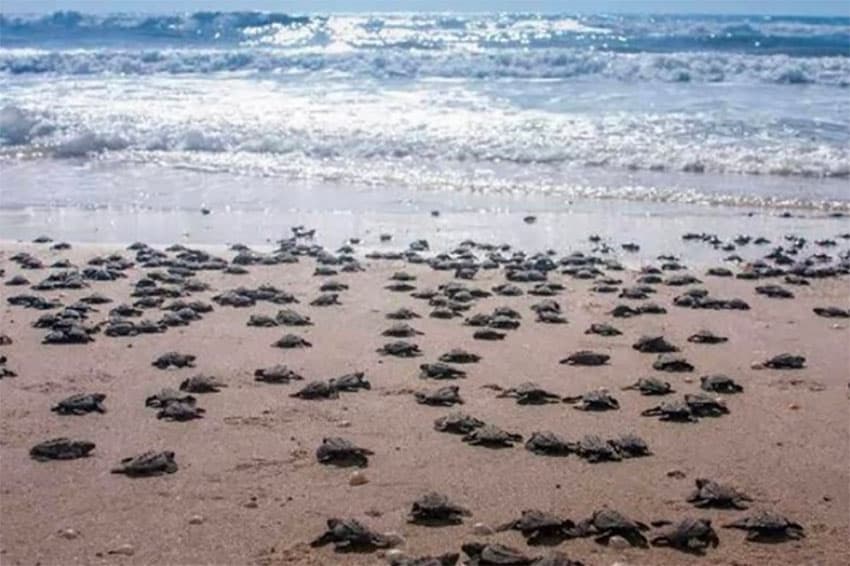
Reduced human activity due to the coronavirus pandemic has been cited as the main reason why a record number of olive ridley sea turtles hatched on a beach in Sonora this year.
Only 500 to 1,000 turtles usually hatch on Playa Mancha Blanca in the Gulf of California in Desemboque, Pitiquito, but 2,289 have already been released into the sea so far this year and the two-week long hatching season still has five days to go.
Mayra Estrella Astorga, coordinator of the conservation group Tortugueros del Desemboque, described the large number of hatchlings as “majestic,” adding that the local community of indigenous Seri, or Comcaac, people have never seen anything like it.
“I believe that it is due to the pandemic. In one way it benefited us, … it was a benefit for us to see more turtles. … During this time they didn’t allow [fishing] boats in,” she said.
“This year has been one of the hardest for our community. The pandemic brought sickness and death to our people, and complicated the economic situation here,” Astorga said in an interview.
“That’s why we are so happy that, in the middle of this tragedy, this miracle of nature happened — as a result of fewer fishing boats and tourists, but also through the efforts of the community.”
On hand to see the release of 720 recently-hatched olive ridley turtles was Rubén Albarrán, singer of the acclaimed rock band Café Tacvba and an environmental activist.

“It really is very beautiful seeing the Comcaac people showing their responsibility and the beautiful relationship they have with their environment,” he said.
“All indigenous people have that connection [to the environment] and profound knowledge about it. They’re the ones who look after these areas that give life to the planet. They’re our big brothers and we can learn from them.”
Olive ridley turtles are the most abundant sea turtle species in the world but they are nevertheless endangered. The global population of the species has declined by 30% to 50% in recent decades, according to the International Union for Conservation of Nature.
The main threats the turtles face are the trafficking of their eggs and illegal and accidental fishing. The species also nests in Oaxaca, where the illegal sale – and consumption – of turtle eggs is particularly common.
Source: El Universal (sp), USA Today (en)