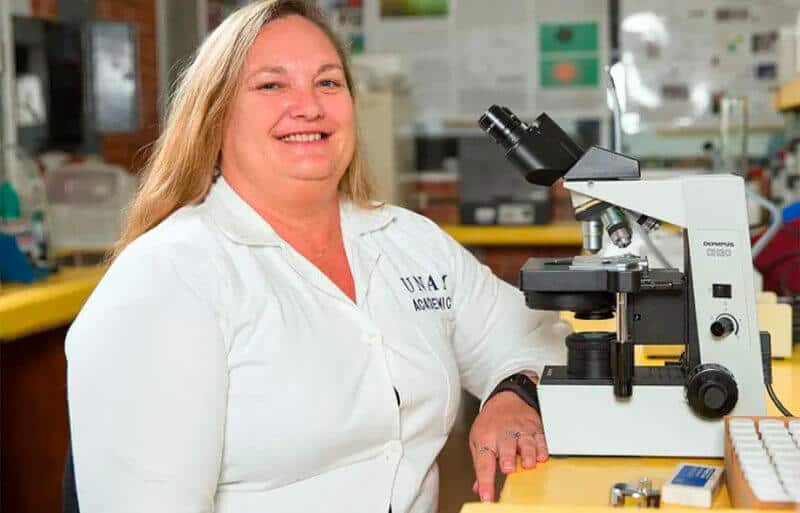
An underfunded researcher at the National Autonomous University (UNAM) can finally obtain the microscope essential to her conservation work after winning a financial award.
Australian-born scientist Anastazia Teresa Banaszak spent two years trying to secure funding to buy the microscope for coral reef conservation work in the Mesoamerican Barrier Reef System. She was announced as one of 10 winners in the 2021 Ben Barres Spotlight Awards, which provide funds to researchers in biology and medicine from lesser represented groups, or from countries with limited research funding.
Prize winners will receive up to $6,000 to aid their work.
Banaszak’s team works to conserve endangered corals in the reef system, which extends from Isla Contoy, located off the northeast coast of Quintana Roo, to the Bay Islands in Honduras. It has been under threat from sargassum and a rise in water temperatures since 2018.
The team uses cryo-preservation to reproduce corals in a lab before replanting them in depleted and damaged reefs. The scientists subsequently monitor the lab-grown coral to determine the success of their assisted reproduction program.
The specialized microscope will be used to measure the quality of coral sperm before and after it is frozen in the lab.
Banaszak said that research funding is rarely available for such specialized work. “We have been trying to get funding to buy a microscope for two years now but granting agencies generally cannot cover more than bare lab expenses and a postdoc salary. This award provides us with a wonderful opportunity to move forward with producing a quality coral biorepository in Mexico while there are still coral colonies left to work with,” she said.

The other winners of this year’s Ben Barres awards were from India, the United States, Rwanda and South Africa. The awards are run by eLife, a non-profit organization which promotes ethical scientific research.
Mexico News Daily