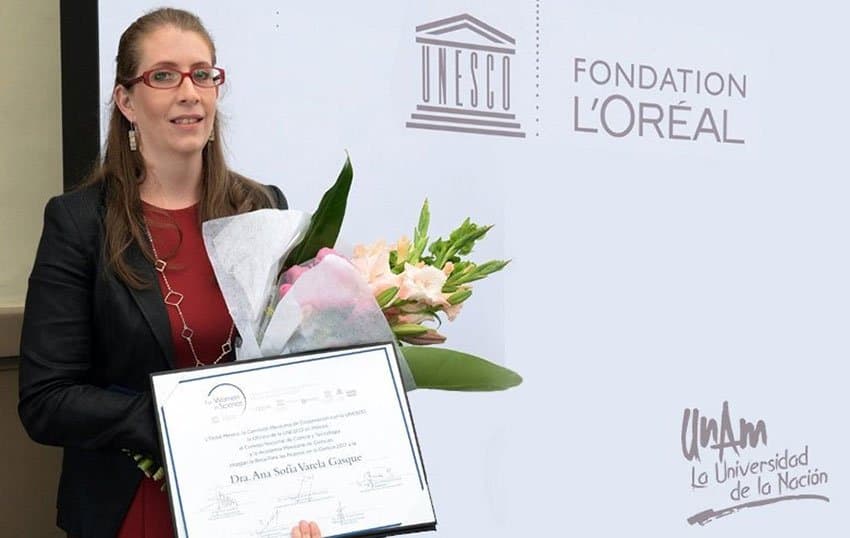
A researcher at the National Autonomous University has been named one of the world’s 15 most promising young scientists by the United Nations Educational, Scientific and Cultural Organization (UNESCO).
Ana Sofía Varela Gasque, a researcher in the university’s chemistry department, was recognized along with 14 others in a ceremony yesterday at the organization’s headquarters in Paris.
Varela said she was singled out for her work on new materials that could allow carbon dioxide to be transformed into non-pollutants.
“What I do is basic science. I am working to understand a chemical process that in the future will help to convert CO2 emissions and reduce its presence in the atmosphere. We work with hydrogen batteries, which is to say that we fuel a battery with hydrogen and transform it using an electrical current. We are looking for materials to make this process as efficient as possible.”
She said the challenge was to find low-cost alternatives to carbon as the catalyst in the reaction. Metals such as copper, gold and silver could be used, for example, but carbon is much more abundant.
Varela said she hoped her research would demonstrate how to best reduce carbon dioxide during the long transition from the burning of fossil fuels to the use of renewable energy sources.
Along with the international exposure to help their professional careers, the young scientists also receive a grant for their research. The awards, which are offered through a partnership with the L’Oréal Foundation, have been presented to 107 promising young scientists since their inauguration.

Another 3,000 scientists have been awarded research scholarships.
The goal of the UNESCO-L’Oréal partnership is to attract more women to a career in science by supporting and recognizing accomplished women researchers, encouraging more young women to enter the profession and to assist them once their careers are in progress.
Source: Notimex (en), ContraRéplica (sp)