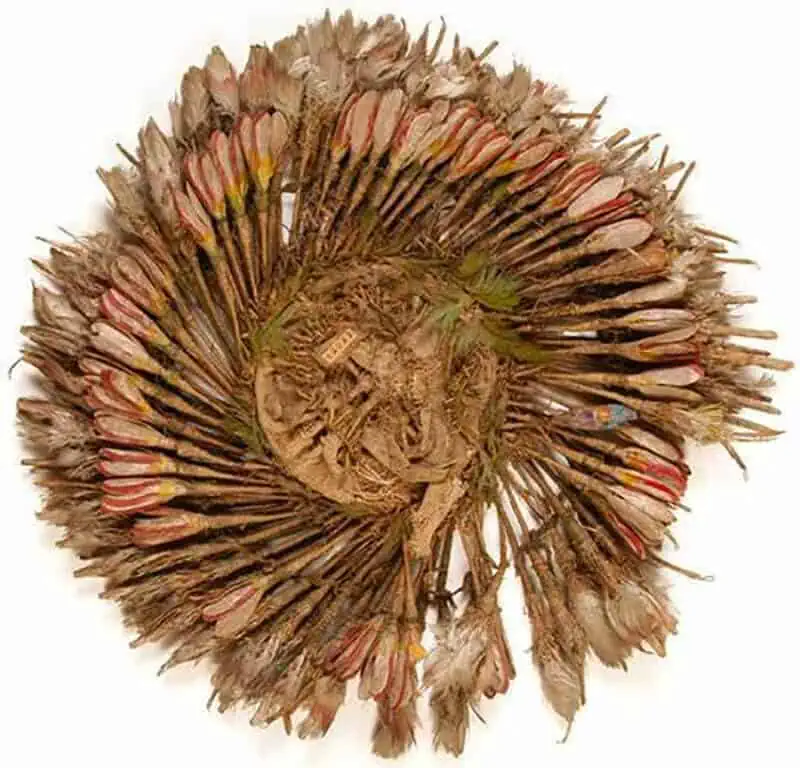
An artifact purported to be the headdress of Aztec tlatoani Cuauhtémoc is not in fact a headdress and didn’t belong to the last ruler of Tenochtitlán, according to a group of Mexican and French researchers.
The penacho de Cuauhtémoc, or Cuauhtémoc’s headdress, is currently on display at the National Museum of Anthropology, which secured a loan of the piece from the Quai Branly Museum in Paris, France. It was sent to Mexico for a temporary exhibition marking the 500th anniversary of the downfall of Tenochtitlán, the Aztec or Mexica capital, and the 200th anniversary of independence from Spain.
But a multidisciplinary team of Mexican and French experts have concluded that the circular artifact – which is mainly made of feathers – is not a headdress (wearing it on the head would be impossible, they deduced) and was made between the 17th and 19th centuries, probably in South America.
The experts sent two minute samples of the purported headdress to a laboratory in Poznan, Poland, which used carbon dating to determine with 75% certainty that it was made between 1626 and 1810. Even the former year is more than 100 years after Cuauhtémoc was executed on the orders of Spanish conquistador Hernán Cortés in 1525.
Eugène Boban, a 19th century French art dealer employed as the personal antiquarian of the Mexican Emperor Maximilian, brokered a sale of the artifact, claiming that it was indeed the headdress of Cuauhtémoc, who ruled Tenochtitlán from 1520 t0 1521.
But Leonardo López Luján, a National Institute of Anthropology and History researcher and member of the team that studied the object, said that Boban made the assertion simply to get a better price.
“You had to say it was pre-Hispanic, Aztec or Inca because Mayan [artifacts] weren’t so well known then, and that it belonged to a king – Cuauhtémoc, Moctezuma or [last Inca Emperor] Atahualpa,” he said.

López said that a lot of artifacts passed through Boban’s hands, and some of them were fake. Two crystal skulls sold by the antiquarian and currently held in the Quai Branly museum and the British Museum in London have been proven to be 19th century fakes rather than pre-Hispanic artifacts.
“There are a lot of pieces like that in Europe because American objects were not well known,” López said.
Although the penacho de Cuauhtémoc apparently didn’t belong to the 16th century tlatoani, it is a “spectacular, very beautiful, very rare ethnological piece,” he said.
However, it has never been put on public display at the Quai Branly Museum due to doubts about its authenticity.
The multidisciplinary expert team – of which Laura Filloy, María Olvido Moreno, Fabienne de Pierrebourg, Stéphanie Elarbi, Christophe Moulherat and Jacques Cousin are also members – hypothesizes that the object was made in either an Amazonian or Andean region of South America.
“It could be part of a scepter. … It wasn’t worn on the head [but] maybe [it was held] in the hand,” López said. “What is clear is that it has nothing in common with the other Aztec feather pieces there are in Europe and Mexico.”
The best known such piece, the penacho de Moctezuma, is on display at the Museum of Ethnology in Vienna, Austria.
With reports from El País