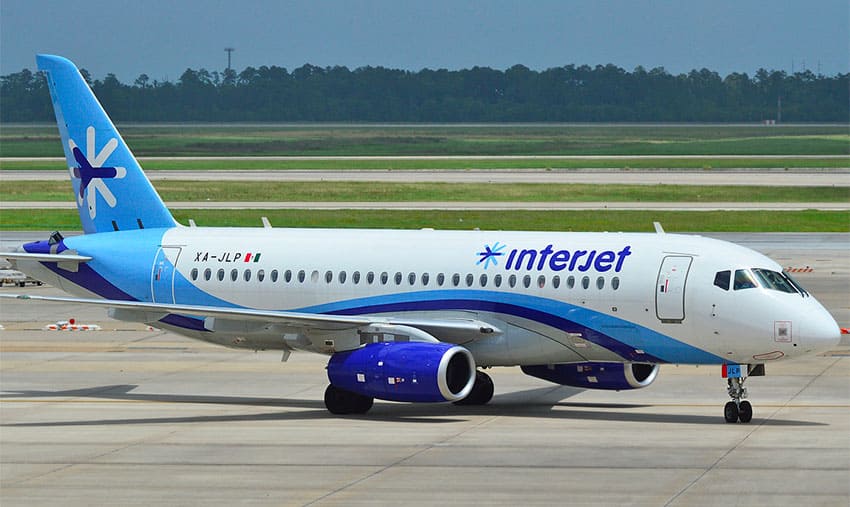
Interjet’s share of the domestic air travel market declined in the first nine months of 2109 due to financial and operational problems, including trouble with its Russian-built planes.
The airline transported 7.86 million passengers between January and September to claim a 19.8% stake in the Mexican market, according to data from the Federal Civil Aviation Agency. In the same period last year, Interjet had a 20.6% share of the market.
Independent aviation consultant Juan Antonio José told the newspaper Reforma that the decline can be partially attributed to the grounding of many of the airline’s Sukhoi Superjet 100s. Interjet has been forced to take most its fleet of 22 Sukhois out of service due to a lack of spare parts.
The airline received about US $40 million in compensation from Sukhoi last year due to the company’s inability to supply parts to planes with mechanical problems in a timely manner.
José said that demand for flights on the planes was also low due to safety concerns, meaning that even if Interjet was able to keep them in the air, they would operate at a loss.
“The reality is that air transport demand reacts particularly aggressively in the face of any perception of a lack of safety . . . If I’m going to take a trip, I want it to be on an airline that guarantees [the safety of] the journey,” he said.
In that context, Interjet is planning to withdraw its remaining operational Sukhoi Superjets from service by the end of the year, and operate exclusively with planes made by European multinational Airbus.

The airline has 64 A320 Airbus planes and, according to a report by the news agency Reuters in October, is close to a deal to purchase 12 A220 passenger jets to replace its grounded Sukhoi fleet.
The inactive Russian planes, purchased by Interjet about six years ago, are located at several airports around the country, the aviation news website Transponder 1200 reported. Interjet reportedly wants to sell the planes although some of them no longer have airworthiness certificates.
The airline ordered 30 Sukhoi jets in 2013 and was still to take delivery of eight. However, in light of the decision to cease operations with the Russian-built planes it appears unlikely that it will be willing to receive them.
While Interjet has lost market share this year, two of its main competitors have increased their share. Volaris captured 31.4% of the domestic air travel market in the first nine months of 2019, up from 27.9% in the same period last year, while VivaAerobus grew its share by one point to 19.8%.
In contrast, Aeroméxico’s market share declined to 24.3% from 28.1% as the result of the grounding of its Boeing 737 MAX planes due to safety concerns.
Source: Reforma (sp), Transponder 1200 (sp)