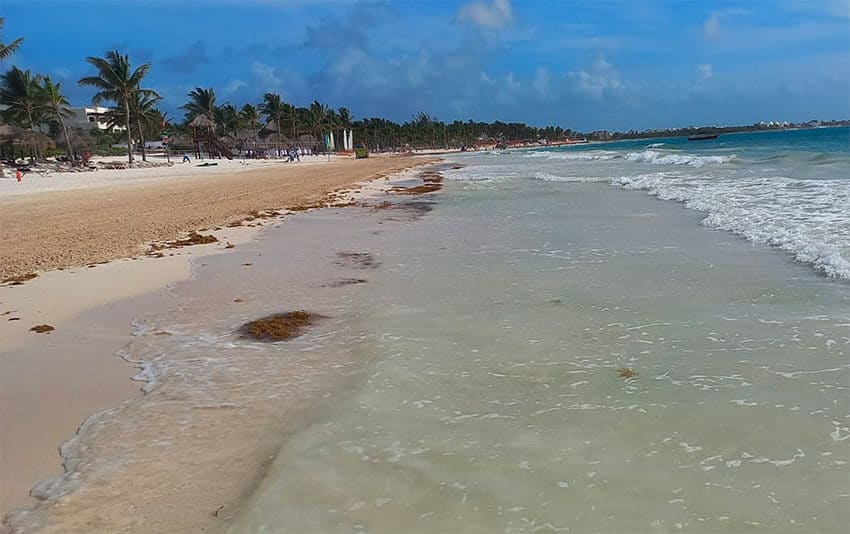
Some of the sargassum collected from the Caribbean Sea and Quintana Roo beaches is ending up in clandestine dump sites, a practice that poses environmental risks.
The number of such places has increased due to the lack of official landfill sites, the newspaper Milenio reported.
The director of the Puerto Morelos branch of Zofemat, the federal office of maritime land zones, condemned the dumping of sargassum in unauthorized locations. “They can’t just dump it on any property … or beside the highway,” Gerardo Rosas said, referring to people who offer sargassum disposal services to authorities and beachfront businesses such as hotels and restaurants.
He added that Zofemat has also detected the disposal of the seaweed in mangrove areas. “That causes a direct impact on the ecosystem, on the wetlands,” Rosas said.
Using specially-designed sargassum-gathering vessels, the navy collects the seaweed from the Caribbean sea off the coast of Quintana Roo and deposits it at the end of each day in containers on docks, Milenio reported. Municipal authorities are then tasked with disposing of the seaweed on land. But they sometimes subcontract the job to people offering disposal services and they dump the sargassum in areas where it shouldn’t be discarded. Such sites don’t have geomembranes – synthetic liners – that prevent toxic liquids called leachates from seeping into the soil.
“Studies tell us that [sargassum] produces leachates [when it decomposes] and it has a high arsenic content,” said navy sargassum strategy coordinator Alejandro López Zenteno. “So how [sargassum] is managed at the time of disposal on land is very important to avoid damage to the water table.”
Managing the seaweed this sargassum season has been a challenge as huge amounts have washed up on Quintana Roo’s coastline. As a result, authorized landfill sites have been overwhelmed by the weed.

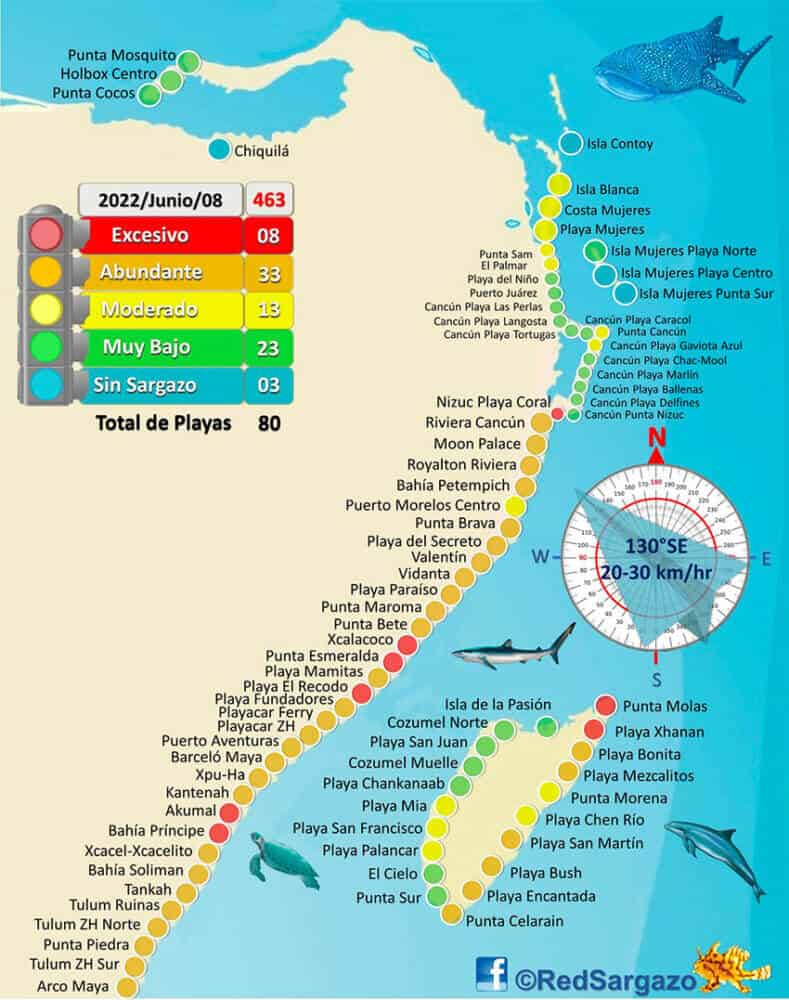
The Quintana Roo sargassum monitoring network’s latest map shows eight Quintana Roo beaches with excessive amounts of sargassum, 33 with abundant amounts and 13 with moderate coverage of the smelly brown seaweed. That’s a significant improvement compared to late May when 50 beaches were plagued by excessive amounts.
Two of the beaches that currently have excessive amounts and six of those with abundant quantities are located on the east coast of Cozumel, an island off the coast of Playa del Carmen. Local Zofemat director Marco Antonio Loeza Pacheco acknowledged that the quantity of sargassum that has reached Cozumel this year has exceeded expectations. Over three tonnes of the weed have been removed from beaches in recent days, he said Monday.
A truck was recently seen dumping sargassum on a Cozumel street, confirming that the improper disposal of the weed is not a problem limited to the Quintana Roo mainland. Loeza urged hotels and beach clubs to consult with authorities so that the sargassum they collect can be disposed of in a place where it won’t pose a risk to the environment.
With reports from Milenio and El Sol de México