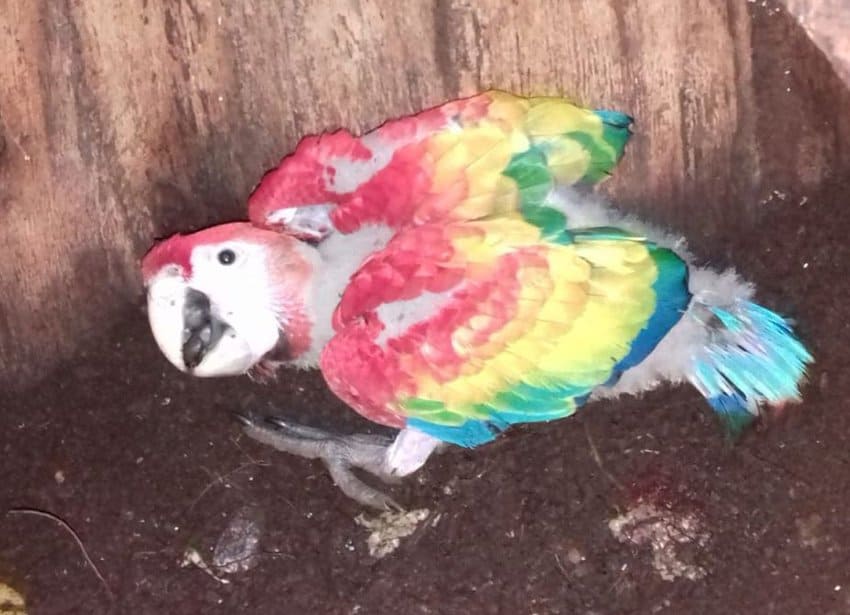
For the first time in 50 years, a scarlet macaw chick has hatched in the wild in the rainforests of Veracruz.
The birth is the result of a rescue plan by biologists at the National Autonomous University (UNAM) in a jungle area of the state’s Tuxtlas region.
Experts from Nanciyaga Ecological Reserve, the Ancient Forest Association and the Xcaret Ecological Park also participated in the project.
Patricia Escalante, a researcher at the UNAM Institute of Biology, said the birth of a chick offers hope both for the success of the rescue plan and the conservation of the species in Mexico.
She added that there was no point releasing the macaws in the area if they didn’t reproduce, stating that “sooner or later” they would disappear again.
Before the conservation project began four years ago, the last time a scarlet macaw was seen in rainforest in the Tuxtlas region was in the 1970s, according to a report published by the university’s news portal UNAM Global.
To encourage the released birds to breed, the project team placed wooden nesting boxes in trees in four release locations that were later checked each month to see if they were being used.

The breeding season of the scarlet macaw, or guacamaya as the bird is known in Spanish, began in March but for three months there was no sign that they had used the boxes for the purpose for which they were intended: to lay eggs.
“We thought there would be no chicks because a lot of time had passed and we hadn’t found anything,” said Omar Gómez, an UNAM student who was responsible for checking the nests.
But in June, five eggs were discovered in a single nest and through observation, the researchers discovered that three macaws were looking after it.
“Two females laid eggs accompanied by the same male,” Escalante explained. But unfortunately, only one chick survived.
A camera was installed in the nest that allows the biologists to monitor the chick and all appears to be going well.
“We’ve left them to raise it on their own, we haven’t intervened and they have protected the chick from possible predators,” Escalante said.
She added that by leaving the chick to be raised without human contact a new generation of completely wild scarlet macaws could begin to inhabit the region.
The species is considered endangered in Mexico, with only about 250 birds estimated to be living in the wild.
The largest population of red macaws in the country live in the Lacandon jungle in Chiapas.
Source: Noticieros Televisa (sp)
Baby macaw captured on video