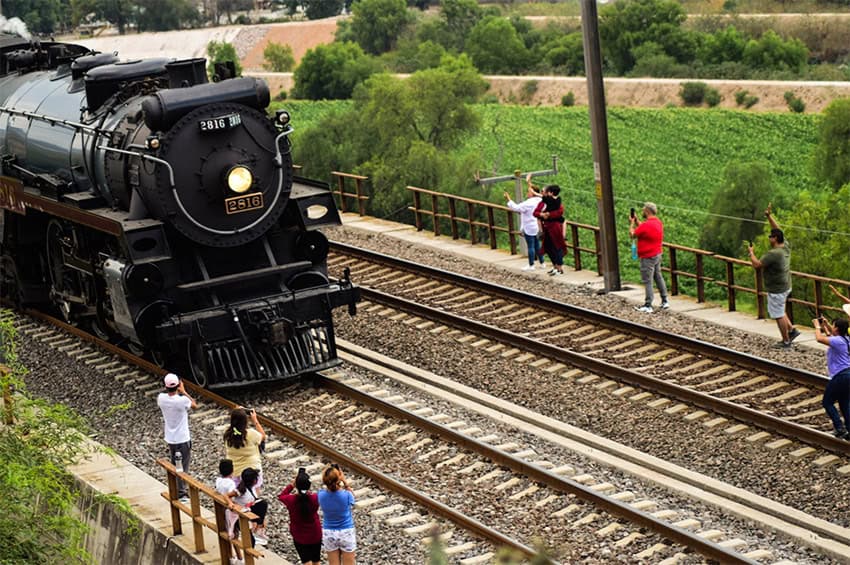
A large crowd turned out in Mexico City on Friday to see Canadian Pacific 2816, a steam locomotive known as the “Empress” that has just completed a lengthy journey to the Mexican capital from Calgary, Canada.
Built by Montreal Locomotive Works for the Canadian Pacific Railway in 1930, the 4-6-4 Hudson-type steam locomotive and its carriages departed Calgary on April 24 on its “Final Spike Anniversary Steam Tour,” a journey that “serves as a reminder of our past and a celebration of our future,” according to Keith Creel, President and CEO of Canadian Pacific Kansas City (CPKC).
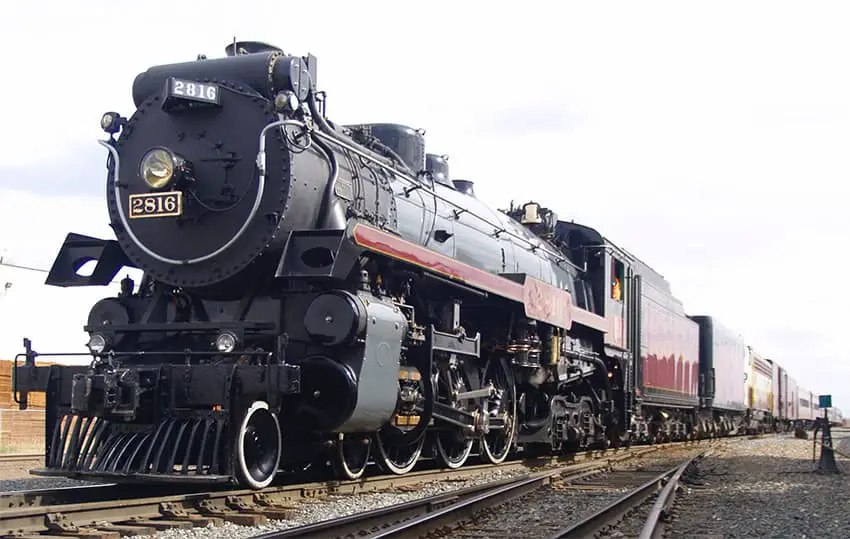
The tour celebrates the first anniversary of the merger of Canadian Pacific and Kansas City Southern.
“Our combination on April 14, 2023, brought together two railroads with long and proud histories that together created the first and only railroad network connecting North America,” Creel said in January when the schedule for the Final Spike tour was announced.
Before reaching Mexico City, the “Empress” made stops in Canadian and United States cities, and in Monterrey, Nuevo León.
At all the stops members of the public had the opportunity to see CP 2816 up close and learn about the locomotive and the history of Canadian Pacific and Kansas City Southern.

One person who went to see the almost 100-year old locomotive in the Nuevo León capital was Ramón Andrade García. He attracted attention because he dressed up as Harry Potter for a photo shoot in front of the steam-locomotive-led train, which resembles the Hogwarts Express.

A tragic accident
On its way to the capital, the “Empress” was involved in a tragic accident when a 29-year-old woman got too close to the tracks and was hit and killed by one of the locomotive’s pistons as she was taking a selfie. The accident occurred as the train passed through the municipality of Nopala de Villagrán, Hidalgo.
In Mexico City, the “Empress” stopped in the Miguel Hidalgo borough on Friday, where hundreds of people came out to admire the locomotive and its adjoined carriages.
At nearly 100 years old, the Empress keeps chugging along
The locomotive pulled passenger trains for 30 years through the 1930s, 40s and 50s before its retirement in 1960. It was subsequently put on display at Steamtown U.S.A, a steam locomotive museum that ran excursions between New Hampshire and Vermont.
Canadian Pacific reacquired the train engine in the late 1990s and put it back into service in 2001 as part of the company’s steam program.
Having reached its final destination in Mexico, the “Empress” will now return to Canada in what appears will be its final journey.
The last “event stop” of the Final Spike tour is July 6 in Winnipeg, the capital of the province of Manitoba. The locomotive will arrive in Calgary on July 10.