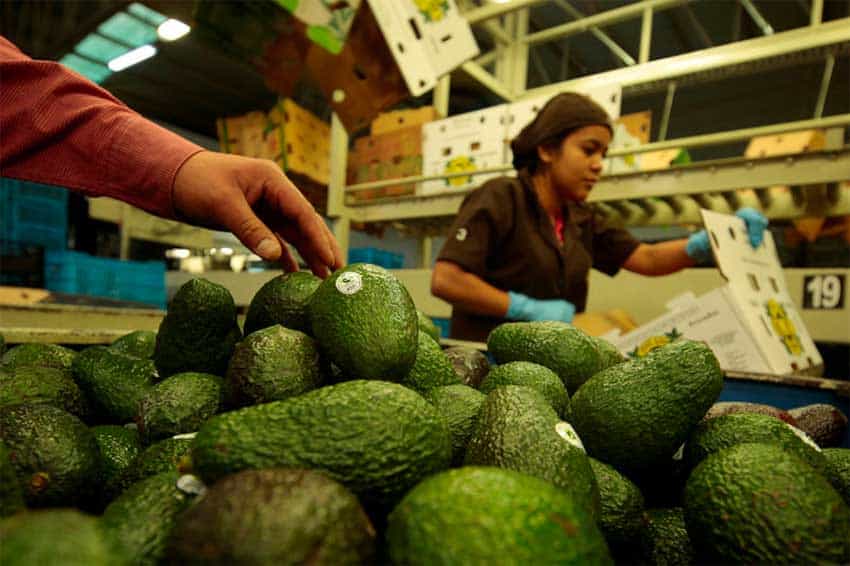
Super Bowl avocado shipments threatened by fuel shortages

The prolonged fuel shortage currently afflicting several states could have an unwelcome consequence in the United States: a lack of avocados with which to make guacamole on Super Bowl Sunday.

Mexican producers ship thousands of tonnes of the fruit to the U.S. in late January and early February to meet increased demand for game day, which this year is February 3.

But the gasoline shortage, caused by the federal government’s decision to change distribution methods as part of its anti-fuel theft strategy, could affect producers’ capacity to get their avocados to people’s homes north of the border.

Mexico’s biggest avocado-growing state, Michoacán, is also the worst affected by the fuel shortage crisis, which has now entered its second week.

Producers in the state expect to send 120,000 tonnes of avocados across the northern border in the lead-up to this year’s Super Bowl, 20,000 more than last year.

“Our three most important weeks of the year are this one and the next two. This is when we ship for Super Bowl week,” Ramón Paz, a spokesman for the APEAM avocado growers’ association, told the news agency Reuters.

“We have from now to January 24, 25 to ship all that volume. If we don’t ship it [by then], we can’t do so later,” Paz said.

To date, 27,000 tonnes of avocados have been shipped for the big sports event.

Paz said the fuel shortage hasn’t yet affected exports to the U.S. but explained that it has begun to make it difficult for workers to get to avocado plantations and to transport the fruit within Mexico.

He added that producers also have regular commitments they need to be able to meet with supermarkets and restaurants in the United States, which depend heavily on Mexican imports.

The avocado growing season in California and Peru won’t restart until March or April and there is only a small quantity of the fruit currently being shipped from Chile, Paz explained.

President López Obrador said yesterday that the government’s anti-fuel theft strategy, which has included the closure of some pipelines, has generated savings of 2.5 billion pesos (US $129.1 million).

Source: Reuters (sp) 

Have something to say? Paid Subscribers get all access to make & read comments.
Manzanillo, Colima, México, 13 de marzo de 2026. La doctora Claudia Sheinbaum Pardo, presidenta Constitucional de los Estados Unidos Mexicanos en conferencia de prensa matutina, “Conferencia del Pueblo” desde Colima. La acompañan Indira Vizcaíno Silva, gobernadora Constitucional del Estado de Colima; Omar García Harfuch, secretario de Seguridad y Protección Ciudadana (SSPC); Raymundo Pedro Morales Ángeles, secretario de Marina (Semar); Bulmaro Juárez Pérez, divulgador de lenguas originarias, presentador de la sección “Suave Patria”; Ricardo Trevilla Trejo, secretario de la Defensa Nacional (Sedena); Jesús Antonio Esteva Medina, secretario de Infraestructura, Comunicaciones y Transportes; Bryant Alejandro García Ramírez, fiscal general del Estado de Colima; Fabián Ricardo Gómez Calcáneo; Rocío Bárcena Molina, subsecretaria de Desarrollo Democrático, Participación Social y Asuntos Religiosos de la Secretaría de Gobernación; Efraín Morales López, director general de la Comisión Nacional del Agua (Conagua); Marcela Figueroa Franco, secretaria ejecutiva del Sistema Nacional de Seguridad Pública (SESNSP) y Guillermo Briseño Lobera, comandante de la Guardia Nacional (GN). Foto: Saúl López / Presidencia

Mexico’s week in review: Congress deals Sheinbaum her first legislative defeat

0
The week of March 9 in Mexico was marked by standoffs between allies in Congress and adversaries at the airport. Here's what you missed.
A soldier displays seized handguns

The US and Mexico, growing together and growing apart: A perspective from our CEO

0
From a historic drop in homicides to opposite bets on electric vehicles, Mexico News Daily's CEO breaks down where the U.S. and Mexico are converging — and where they're not.
Veracruz Gov.

Veracruz governor blames private vessel for 200-kilometer Gulf Coast oil spill

1
The spill, which has spread to over 200 kilometers of Mexico's Gulf Coast beaches, has been traced to a private oil tanker off the coast of Tabasco.
BETA Version - Powered by Perplexity